Resident Evil: The Birth of Survival Horror
How Capcom's 1996 Resident Evil defined the survival horror genre with limited resources, fixed camera angles, tank controls, and a haunted mansion that still terrifies players — full review, mechanics breakdown, and series legacy.
Last updated:
Quick Answer
Resident Evil did not invent horror games, but it invented the survival horror genre as we know it. Released by Capcom in 1996 for the PlayStation, it combined limited ammunition and healing items, fixed camera angles, deliberately awkward “tank controls,” and a slow-burn haunted mansion atmosphere to create a new kind of tension — one where the player is constantly making uncomfortable decisions about what to carry, what to fight, and whether to save. It was a hit that spawned a multibillion-dollar franchise and influenced every horror game that followed.
Last Updated
Content reviewed May 2026. Sales figures confirmed via Capcom’s public investor reports. Platform availability verified at time of writing.
Who This Guide Is For
- Retro horror fans curious about the game that defined survival horror as a genre
- Players who have only played the modern remakes and want to understand the original
- PlayStation collectors and retro gaming enthusiasts
- Anyone interested in how early 3D games created atmosphere through limitation
Key Takeaways
- Resident Evil (1996) established the survival horror template: limited resources, vulnerable protagonists, puzzle-driven exploration
- The tank controls and fixed camera angles were deliberate design choices that increased tension, not technical limitations
- Jill Valentine’s campaign is the beginner-friendly route; Chris Redfield’s is hard mode with fewer inventory slots and no lockpick
- The game sold over 5 million copies on PS1 and spawned a franchise exceeding 160 million total sales
- The 2002 GameCube remake (available as HD Remaster on modern platforms) is the definitive version of the original
- Each gameplay system — inventory, saving, combat, movement — was designed to make the player feel vulnerable and resource-constrained
The Haunted House That Changed Everything
Shinji Mikami, the director of Resident Evil, has said he wanted to make a game that felt like being inside a horror movie. His reference points were George Romero’s zombie films and the 1989 Capcom RPG Sweet Home, a Japan-only Famicom game based on a horror film that featured a mansion, a party of characters, and limited item management.
The result was a game set almost entirely inside a single location: the Spencer Mansion, a sprawling Gothic estate in the Arklay Mountains. The player, as either Jill Valentine or Chris Redfield, arrives with the STARS Alpha team to investigate bizarre murders. Within minutes, the team is scattered, a helicopter departs, and the player is alone — or almost alone — in a building full of locked doors, cryptic puzzles, and shambling undead.
The mansion itself is the game’s true main character. Room by room, the player assembles a mental map: the dining room connects to the hallway, the hallway to the save room, the save room to the east wing. Every door requires a specific key — Sword Key, Armor Key, Shield Key, Helmet Key — and the player must remember which one opens what. This metroidvania-like gating, combined with a genuinely unsettling atmosphere, made exploration feel like genuine discovery rather than level progression.
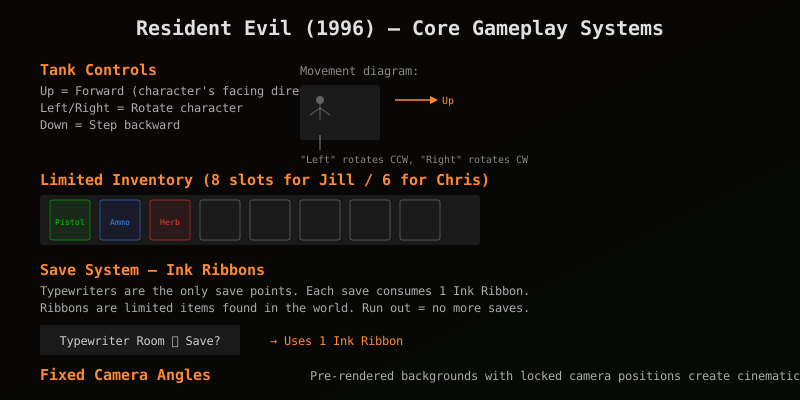 The four core systems — tank controls, limited inventory, typewriter saves, and fixed cameras — were designed to make the player feel constantly vulnerable.
How the Gameplay Systems Built Tension
Every mechanic in Resident Evil serves a single purpose: making the player feel unsafe. The game is not mechanically difficult in the way a precision platformer is. Instead, it creates constant low-level anxiety through resource scarcity and uncertainty.
Tank Controls
“Tank controls” refers to a movement system where up on the d-pad always moves the character forward relative to their facing direction, and left/right rotate them. The criticism — that it feels clumsy — misses the point. The controls are awkward by design. When a zombie is shambling toward you and pressing left doesn’t dodge but instead turns your character, it creates a specific kind of panic. The player is not a nimble action hero. They are a police officer trapped in a nightmare who moves like a normal human being.
The fixed camera angles make this work technically. Because the camera changes with every room transition, a standard relative-direction system (up = north on screen) would cause disorienting shifts every time the angle changed. Tank-relative movement ensures the player’s inputs remain consistent regardless of camera position.
Limited Inventory
Jill has eight inventory slots. Chris has six. Every item — weapons, ammunition, healing herbs, key items, even the Ink Ribbons used for saving — consumes a slot. There is no item storage system; excess items must be left in the environment and retrieved later.
This creates a constant series of micro-decisions. Do you carry the shotgun, which takes one slot, plus the shotgun ammo, which takes another? That leaves four slots for everything else. Do you bring a healing item, or hope you won’t need it and free space for a key item? The optimal play pattern is to leave everything in a safe room — the iconic typewriter rooms with calming save music — and venture out with minimal inventory. But that means long backtracking trips if you encounter something you weren’t prepared for.
Ink Ribbon Saves
You can only save the game at typewriters. Each save consumes one Ink Ribbon. Ribbons are finite items found in the world. If you run out of ribbons, you can no longer save. This system is brilliant psychological design. Every save is a minor resource cost. Players must decide whether the progress they’ve made since their last save is worth spending a ribbon on, or whether to push forward and risk losing more.
Modern autosave systems make this concept nearly extinct, and good riddance in many cases, but the Ink Ribbon system gave Resident Evil a unique texture. Every decision carried weight because the safety net had holes in it.
Fixed Camera Angles
The pre-rendered backgrounds and fixed camera angles are the game’s most distinctive visual feature. Instead of a following camera or a first-person view, each room presents a cinematic shot — sometimes a wide angle from a corner, sometimes a close-up, often positioned so that you can hear an enemy before you can see it.
This technique created genuine scares. The famous “dog hallway” — where zombie dogs crash through a window in an L-shaped corridor — works because the camera angle hides the windows until the player is halfway down the hall. The first Hunter encounter in the mansion’s return trip works because you hear its footsteps before the camera reveals the creature.
Jill vs. Chris: Two Different Games
One of the game’s smartest structural decisions was offering two playable characters with meaningfully different campaigns:
Jill Valentine — The easier route. Eight inventory slots. Starts with a pistol and gains access to the grenade launcher and lockpick. Barry Burton assists her at several key moments. More story context and dialogue.
Chris Redfield — The harder route. Six inventory slots. No lockpick — must find small keys to open locked doors. Takes more damage from enemies. Rebecca Chambers assists him. Fewer healing items in his campaign.
The difference is substantial. Jill’s campaign is the recommended starting point. Chris’s run feels like a new game plus hard mode, forcing more careful inventory management and more consequential combat decisions.
The Voice Acting: So Bad It Became Legendary
Resident Evil’s English voice acting is famously terrible. Lines like “You were almost a Jill sandwich,” “Master of unlocking,” and “It’s a weapon — it’s really powerful, especially against living things” have become immortal memes in gaming culture.
The localization was done in-house by Capcom Japan with a small budget and little quality control. The English cast was non-union, largely inexperienced, and given minimal direction. The result is dialogue that sounds unnatural in ways that somehow enhance the game’s B-movie horror aesthetic.
It is difficult to separate whether the terrible acting helps or hurts the atmosphere. For many players, the stilted delivery adds to the game’s charm — it feels like a low-budget horror film, which is exactly what Mikami was aiming for. For others, it undermines the tension. Either way, it is an inseparable part of the original game’s identity.
The Legacy of the Spencer Mansion
Resident Evil was a commercial success and a critical one. By 1998, Capcom had shipped Resident Evil 2, which refined the formula with better graphics, a larger scope, and the innovative “zapping” system where actions in one character’s campaign affected the other. Resident Evil 3: Nemesis (1999) introduced the stalker enemy — a persistent, unkillable pursuer that added a new dimension of tension. Resident Evil — Code: Veronica (2000) brought the series to the Dreamcast with full 3D environments.
Then Resident Evil 4 (2005) changed everything again. The over-the-shoulder camera and more action-oriented combat redefined third-person shooters as thoroughly as the original had defined survival horror. The modern remakes — RE2 (2019), RE3 (2020), RE4 (2023) — have been among Capcom’s best-selling and best-reviewed games.
The original 1996 game is still available through the Resident Evil Director’s Cut on PlayStation Network, and the 2002 GameCube remake is easily the better way to experience the Spencer Mansion for the first time. But the original — with its grainy FMV intro of real actors in bad costumes, its “Jill sandwich,” and its cramped inventory — remains essential historical context for anyone who cares about the evolution of video game horror.
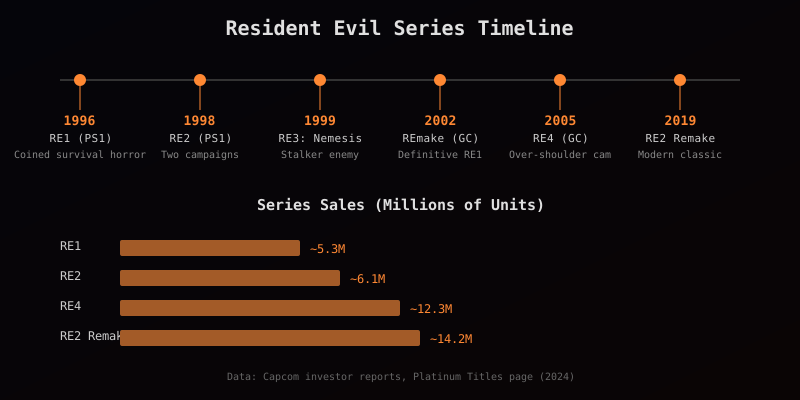 From 1996 to the modern remakes — the Resident Evil series timeline shows how each entry iterated on the formula.
Common Mistakes
- Killing every zombie you see: Zombies that aren’t decapitated or burned will return later as faster, stronger “Crimson Heads” (in the remake). In the original, they simply rise again. Run past enemies in hallways you won’t revisit. Save ammo for boss fights and mandatory encounters.
- Carrying too much: Both Jill and Chris should travel light. Leave everything unnecessary in the nearest save room. Carry one weapon, one ammo type, one healing item, and leave the rest of your slots for key items.
- Saving too often: Ink Ribbons are finite. A good cadence is one save every 30–45 minutes of progress. Use the first playthrough to learn the save room locations and ribbon spawns. On repeat playthroughs you’ll know when to save.
- Ignoring the map: The in-game map marks doors as locked (red), unlocked (green), or current room (blue). Rooms turn green when all items have been collected. Use the map religiously — it is the most important tool in the game.
Author Tip
The single most valuable piece of knowledge for a first playthrough: the shotgun is your best friend. Aim up with the shotgun as a zombie gets close and you can decapitate it in one shot. This prevents resurrection and saves enormous amounts of ammo over the course of the game. The pistol should only be used for distant enemies or when the shotgun is empty.
Editor Note
This article covers the original 1996 release and its immediate impact. The 2002 remake, the modern RE Engine remakes, and the action-focused entries (RE4 through RE6) are distinct experiences that deserve their own coverage. The original’s historical importance does not mean it is the best way to play the game today — the 2002 REmake is widely considered the definitive version of the Spencer Mansion story.
Sources
- Wikipedia — Resident Evil release history and production details: https://en.wikipedia.org/wiki/Resident_Evil_(1996_video_game)
- MobyGames — Credits, versions, and technical details: https://www.mobygames.com/game/482/resident-evil/
- Hardcore Gaming 101 — Series retrospective and design analysis: https://www.hardcoregaming101.net/resident-evil/
- Capcom Investor Relations — Platinum Titles page for sales data: https://www.capcom.co.jp/ir/english/business/million.html
- IGN — History of Resident Evil feature: https://www.ign.com/articles/the-history-of-resident-evil
FAQ
What is the ‘survival horror’ genre? Survival horror is defined by resource scarcity (limited ammo, healing items), vulnerable player characters, environmental puzzle-solving, and tension over action. Resident Evil established this template. The player constantly weighs whether to fight, flee, or conserve resources.
Is tank controls a design flaw or a feature? Intentionally designed. Tank controls keep inputs consistent across fixed camera angle changes and deliberately limit the player’s mobility to increase tension. The remake offers an alternative “modern” control scheme for players who prefer it.
Which character should I play first? Jill Valentine. Eight inventory slots, the lockpick, and the grenade launcher make her campaign significantly more forgiving. Chris’s campaign functions as hard mode — save it for after you know the mansion layout.
Why is the voice acting so bad? Capcom Japan handled the English localization in-house with a very small budget, non-union actors, and minimal direction. The result is famously stilted but has become part of the game’s B-movie charm. Later entries improved significantly.
Is the original still scary? The atmosphere and sound design remain effective. The low-polygon graphics may reduce immersion for modern audiences, but the game’s structural tension — ammo scarcity, limited saves, unknown threats behind every door — still generates genuine unease.
Frequently Asked Questions
- When was Resident Evil first released?
- Resident Evil (known as Biohazard in Japan) was released for the PlayStation on March 22, 1996 in Japan and March 30, 1996 in North America. The European release followed on August 1, 1996. It was later ported to the Sega Saturn, PC, and Nintendo DS.
- What is 'survival horror' as a genre?
- Survival horror is a subgenre of horror games defined by limited resources (ammo, healing items), vulnerable protagonists, environmental puzzle-solving, and an emphasis on tension over action. Resident Evil established these mechanics, though Capcom used the term 'survival horror' for marketing. The genre requires players to manage scarce supplies and decide whether to fight or flee.
- Why does Resident Evil use tank controls?
- Tank controls (Up = forward based on the character's facing direction) were designed to work with pre-rendered backgrounds and fixed camera angles. As the camera angle changes, 'Up' always moves the character forward rather than causing disorienting direction shifts. It also intentionally limits player mobility, increasing tension.
- Who are the main characters in Resident Evil?
- You can play as either Chris Redfield or Jill Valentine, both members of the STARS Alpha team. Jill's scenario is easier (8 inventory slots, lockpick, grenade launcher); Chris's is harder (6 slots, no lockpick, must find small keys). Both campaigns follow the same basic story with different character interactions.
- Is the original Resident Evil still playable?
- The 2002 GameCube remake (available on modern platforms as Resident Evil HD Remaster) is the definitive version. The original 1996 release is historically significant but has aged poorly in voice acting and presentation. The remake preserves the gameplay while vastly improving the visuals and atmosphere.