Final Fantasy VII: The RPG That Made PlayStation Feel Cinematic
How Final Fantasy VII broke RPG conventions, sold the PlayStation as a storytelling machine, and set the template for cinematic game narrative — full review with Materia system breakdown and legacy analysis.
Last updated:
Quick Answer
Final Fantasy VII did not invent the Japanese RPG, but it made the genre feel like a film. Released in 1997 for the original PlayStation, it was the first mainline Final Fantasy to use 3D graphics, pre-rendered cinematic backgrounds, and full-motion video cutscenes. It turned a turn-based role-playing game into a massive mainstream hit — selling roughly 10 million copies and proving that story-driven games could compete with action titles for console audiences. It remains one of the most influential RPGs ever made.
Last Updated
Content reviewed May 2026. Sales figures and version availability confirmed at time of writing. Platform store listings change — verify current pricing before purchasing.
Who This Guide Is For
- RPG fans curious about the game that defined cinematic game storytelling
- PlayStation retro collectors looking for context on the console’s most important exclusive
- Players who only know the 2020 Remake and want to understand the original
- Anyone interested in how a turn-based RPG became a global cultural phenomenon in 1997
Key Takeaways
- Final Fantasy VII was the first 3D mainline FF, the first released in Europe, and the first with a truly global marketing push
- Its $145 million combined development and marketing budget was unprecedented for a video game in 1997
- The Materia system gave players deep customization while remaining accessible to newcomers
- Pre-rendered backgrounds and 40 minutes of FMV cutscenes created a cinematic quality that sold the PlayStation as a storytelling platform
- The game proved RPGs could be blockbuster entertainment — it directly influenced the entire genre’s shift toward narrative focus
- The original still holds up for its story, systems, and Nobuo Uematsu’s soundtrack
The Moment Everything Changed
Before Final Fantasy VII, role-playing games were a niche genre. Titles like Chrono Trigger and Final Fantasy VI were critically acclaimed, but their sales were dwarfed by action games, platformers, and fighting games. RPGs had elaborate stories and deep mechanics, but they rarely crossed into the mainstream consciousness.
Square Soft (now Square Enix) bet the company on a different approach. Instead of building on the SNES with another 2D sprite-based game, they partnered with Sony for the new PlayStation. The pitch was simple: what if an RPG looked and felt like a movie?
The result was staggering. FFVII opened with a sweeping aerial shot of Midgar, a dystopian city of steel plates and reactor towers, scored to swelling orchestral synthesizers. The protagonist, Cloud Strife, leapt from a train and the player was immediately thrust into a bombing mission. No menu dumps, no tutorial pop-ups, no slow build. The game opened like an action movie.
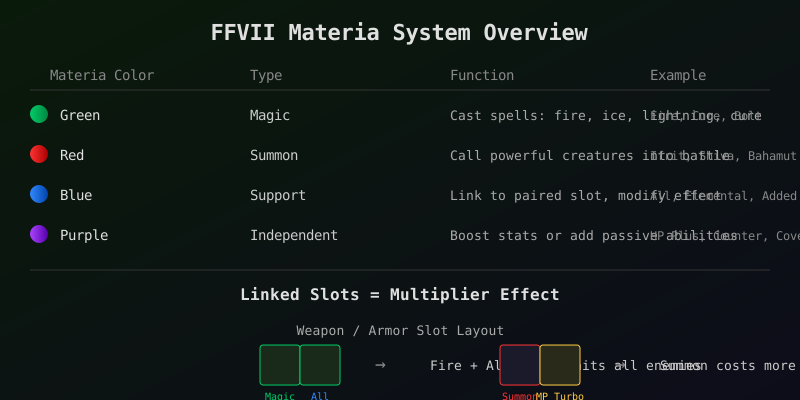 The Materia system: each color represents a different ability type. Linked slots create powerful combination effects.
What Made the Gameplay Work
FFVII used the Active Time Battle (ATB) system that had evolved across previous entries since Final Fantasy IV. Characters had a gauge that filled in real time. When full, you could issue a command. It was turn-based but with a sense of urgency.
The real innovation was the Materia system. Instead of fixed character classes, every party member could equip any combination of Materia — colored orbs that granted spells, summons, commands, and passive abilities. This created an almost infinite number of builds.
Materia came in five colors:
- Green — Magic: Fire, Cure, Bolt, Contain, Ultima — standard spellcasting
- Red — Summon: Ifrit, Shiva, Bahamut, Knights of the Round — powerful creature attacks
- Yellow — Command: Steal, Throw, Morph, Deathblow — active battle commands
- Blue — Support: All, Elemental, Added Effect, MP Turbo — modifies linked materia
- Purple — Independent: HP Plus, Counter, Cover, Luck Plus — passive stat boosts
The linked slot system was where the depth emerged. Every weapon and armor piece had slots arranged in pairs. Placing a Support materia next to a Magic or Summon materia combined their effects. Fire + All meant casting fire on every enemy. Cure + All was the most efficient healing setup in the game. Elemental + Fire on your weapon meant dealing fire damage with every attack; Elemental + Fire on your armor meant absorbing fire damage.
This system rewarded experimentation. A player could build Cloud as a pure black mage, a tank with high HP and Counter, or a hybrid with healing and summons. The game never locked anyone into a single role.
The downside was that the battles were not especially difficult. FFVII is a forgiving RPG. Random encounters are frequent, and you can overpower most bosses through normal leveling. The challenge came from optional fights: Emerald Weapon and Ruby Weapon, two superbosses hidden in the post-game, required genuine strategic planning and specific Materia loadouts. Beating them without a guide was a badge of honor in the pre-internet era.
The Story That Defined a Generation
FFVII’s plot has become so iconic that summarizing it feels redundant — but that familiarity is a testament to its cultural reach. Cloud Strife, an ex-SOLDIER turned mercenary, joins an eco-terrorist group called AVALANCHE to sabotage the Shinra Electric Power Company, which is literally draining the planet’s life energy. What begins as industrial sabotage spirals into a conflict with Sephiroth, a genetically enhanced super-soldier who intends to wound the planet itself and absorb its energy to become a god.
The story worked because it balanced operatic stakes with intimate character moments. Cloud’s identity crisis, Aerith’s fate, Barret’s paternal guilt, Tifa’s loyalty, Red XIII’s dignity — these were characters players genuinely invested in. The pre-rendered backgrounds gave every location a distinct visual identity: the slums of Sector 7, the neon glamour of the Gold Saucer, the eerie stillness of the Forgotten City.
And then there was the moment. Midway through the game, a sequence that had no precedent in mainstream gaming. Aerith, a central party member and Cloud’s closest companion, was killed by Sephiroth. It was permanent. She was removed from the party, her Materia returned to inventory, her character arc concluded. No revive item, no Phoenix Down. Just a burial at the bottom of a lake and Nobuo Uematsu’s “Aerith’s Theme” playing over the subsequent Jenova boss fight — a piece of music that millions of players will never forget.
This single moment changed what players expected from video game stories. Characters could die and stay dead. Stories could have genuine emotional stakes. Games were no longer just about beating the final boss — they were about the journey and what it cost.
The Soundtrack: Uematsu’s Masterwork
Nobuo Uematsu’s Final Fantasy VII score is one of the most celebrated video game soundtracks of all time. Working with the PlayStation’s CD-quality audio — a massive leap from the SNES sound chip — Uematsu composed 85 tracks spanning orchestral, industrial, jazz, and ambient styles.
Key tracks:
- Opening ~ Bombing Mission: The game’s first minutes are scored to a track that moves from atmospheric tension to triumphant brass. It sets the cinematic tone immediately.
- Aerith’s Theme: A gentle, melancholy melody that becomes the emotional center of the story. Its use during and after Aerith’s death is one of gaming’s most effective marriages of music and narrative.
- One-Winged Angel: The final boss theme. A Latin choral piece — unheard of in video game music at the time — and still used as Sephiroth’s theme in every subsequent appearance.
- Cosmo Canyon: A spiritual, drum-driven piece reflecting Red XIII’s tribal homeland. Demonstrates Uematsu’s range beyond orchestral bombast.
The soundtrack has been performed by full orchestras worldwide (Distant Worlds concert series) and remixed across dozens of official albums. It remains a benchmark for what game music can achieve.
The FMV Revolution
Final Fantasy VII contained roughly 40 minutes of full-motion video cutscenes. By modern standards, the low-resolution, heavily compressed video looks primitive. In 1997, it was revolutionary.
These cutscenes served two purposes. The first was spectacle: summons like Bahamut ZERO and Knights of the Round were jaw-dropping visual setpieces that made players feel like they were watching a film. The second was narrative punctuation: key story moments — Midgar’s destruction, Aerith’s death, the final confrontation — were rendered in full video to maximize their emotional impact.
Square’s FMV pipeline was so advanced that they briefly considered launching a dedicated film division. That ambition eventually produced Final Fantasy: The Spirits Within (2001), a box-office failure that nearly bankrupted the company. But the FMV approach inside FFVII itself was a masterstroke. It sold the PlayStation as a machine that could deliver experiences no cartridge-based console could match.
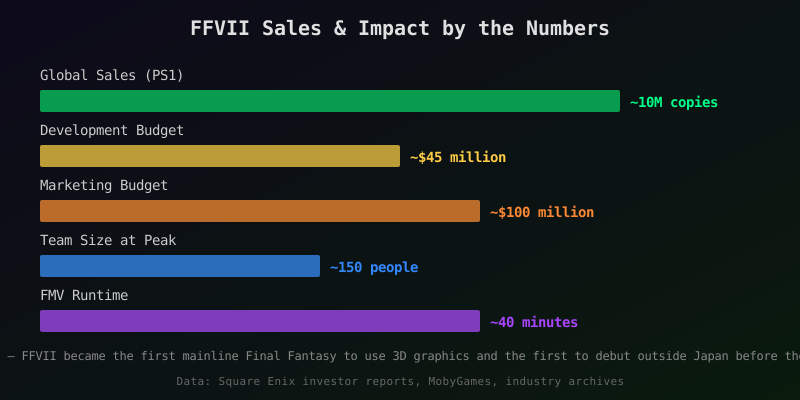 FFVII by the numbers — the game’s production scale was unprecedented for 1997.
PlayStation’s Killer App
Nintendo’s decision to stick with cartridges for the Nintendo 64 handed Sony a decisive advantage. Cartridges were faster to load but limited to roughly 64MB of storage. A single PlayStation CD held 650MB. That space let FFVII include its FMV sequences, its massive soundtrack as CD audio, and its 3 CDs of content.
The result was a game that could not exist on the N64. Final Fantasy VII moved PlayStation consoles. In Japan, the game sold over 2 million copies in its first three days. In North America, Sony backed it with a $100 million marketing campaign — an unthinkable sum for a turn-based RPG. The ads didn’t show menus or battle screens. They showed cutscenes. They sold the game like a blockbuster movie.
It worked. Final Fantasy VII legitimized the PlayStation as the platform for story-driven experiences. Every major RPG franchise that followed — from Xenogears to Final Fantasy VIII to Kingdom Hearts — built on the template FFVII established: 3D characters on pre-rendered backgrounds, FMV cutscenes, and a sweeping orchestral score.
Common Mistakes
- Ignoring Enemy Skill materia: The Enemy Skill materia lets you learn monster abilities including some of the best healing and damage options in the game. Big Guard (learned from Beachplugs near Costa del Sol) casts Barrier, MBarrier, and Haste on the entire party. White Wind heals everyone. These are free and incredibly powerful.
- Selling old Materia: Materia levels up through use and never becomes obsolete. A mastered All materia sells for 1.4 million gil and breeds a new All materia when maxed — effectively infinite money.
- Skipping Yuffie and Vincent: Both are optional characters. Yuffie is one of the best physical damage dealers with her Conformer weapon (scales with enemy level). Vincent’s Limit Breaks transform him into powerful monsters. They are worth recruiting.
- Fighting Ruby Weapon unprepared: Ruby Weapon instantly removes two party members. Enter the fight with two characters KO’d and the survivor equipped with Hades + Added Effect on their weapon. This inflicts Stop on Ruby, buying time to revive the party.
Author Tip
The best single piece of advice for a first playthrough: talk to everyone and explore every screen. FFVII hides some of its best content — the Wutai sidequest, the Gold Saucer date mechanics, the ancient forest — behind NPC dialogue and optional paths. The game rewards curiosity. And do not sell the “Steal” materia. Steal gets you weapons and accessories well before shops sell them.
Editor Note
This article focuses on the original 1997 release. The 2020 Final Fantasy VII Remake and its sequels are fundamentally different games — action-RPG combat, expanded storylines, and completely rebuilt environments. They are interpretations, not replacements. The original remains a distinct experience worth playing on its own terms.
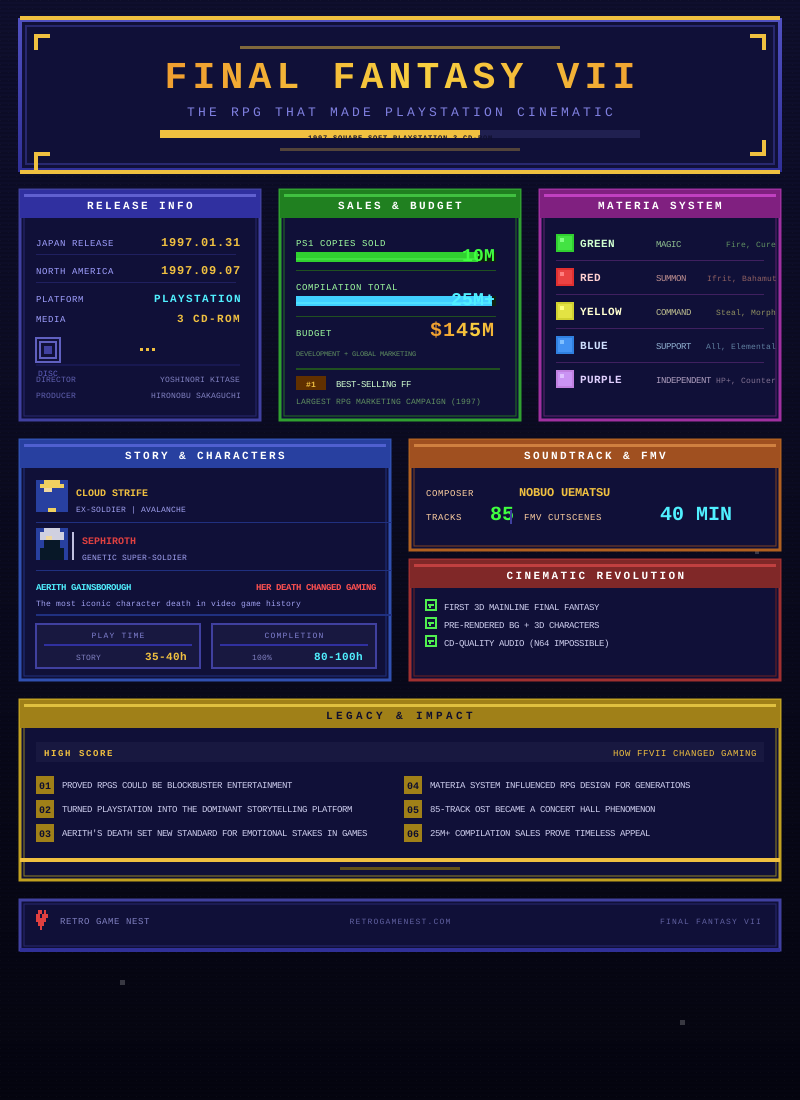 Final Fantasy VII pixel art infographic — 1997 PlayStation release, 10 million sales, Materia system, story, and legacy
Sources
- Hardcore Gaming 101 — Final Fantasy VII retrospective and series context: https://www.hardcoregaming101.net/final-fantasy-vii/
- MobyGames — Release data, credits, and version tracking: https://www.mobygames.com/game/572/final-fantasy-vii/
- Wikipedia — Sales figures and production history: https://en.wikipedia.org/wiki/Final_Fantasy_VII
- Square Enix Official — Current availability and Remake project info: https://finalfantasyvii.square-enix-games.com/
- Polygon — “The Making of Final Fantasy 7” deep-dive feature: https://www.polygon.com/a/final-fantasy-7
FAQ
Is the original FFVII better than the Remake? They are different experiences. The original has the complete story, the full Materia system, and a focused ~40-hour runtime. The Remake has modern action combat, vastly expanded Midgar content, and dramatically better presentation. Play both — they complement each other.
What is the best version of the original FFVII to play today? The Steam version with the SYW (Satsuki Yatoshi Works) mod for upscaled backgrounds and character models is widely considered the best way to play. The Switch and PS4 versions are solid console options. Avoid the original PC CD-ROM release — it has MIDI audio and compatibility issues.
How long does it take to beat FFVII? Main story: approximately 35–40 hours. With side quests, optional characters, and superbosses: 60–80 hours. A full completion with all Materia mastered and both Weapons defeated: 80–100+ hours.
Why did Square switch from Nintendo to Sony for FFVII? Nintendo’s N64 used cartridges, which capped storage at ~64MB. FFVII’s FMV, CD-quality audio, and 3 CDs of content required the 650MB capacity of CD-ROM. The PlayStation was the only viable platform for the game Square wanted to make.
Who is the best party member mechanically? Cloud is fixed as the party leader and is strong in every role. Cid has the best overall Limit Breaks (Highwind hits all enemies multiple times). Yuffie with the Conformer weapon is the strongest against high-level enemies. Barret with the Missing Score deals damage equal to the AP of his equipped Materia — potentially the highest damage in the game.
Frequently Asked Questions
- When was Final Fantasy VII released?
- Final Fantasy VII was released in Japan on January 31, 1997, and in North America on September 7, 1997. The European release followed on November 17, 1997. It was the first mainline Final Fantasy to be released in Europe at launch.
- How many copies did Final Fantasy VII sell?
- The original PlayStation version sold approximately 10 million copies worldwide, making it the best-selling title in any Final Fantasy platform generation. Combined with later ports and the Remake series, the FFVII compilation has sold over 25 million units.
- What is the Materia system in FFVII?
- Materia are colored orbs that you slot into weapons and armor. Green materia grants magic spells, red grants summon monsters, yellow grants command abilities, blue provides support effects that link to paired slots, and purple provides independent passive bonuses. Linked slots combine effects — pairing Fire with All makes fire hit all enemies.
- Why was Final Fantasy VII so impactful?
- It was the first mainline FF to use 3D graphics and pre-rendered backgrounds with full-motion video cutscenes, creating a cinematic experience unseen in RPGs at the time. Combined with a $100 million marketing campaign, it turned the PlayStation into the dominant console for story-driven games.
- Is the original FFVII still worth playing?
- Yes. While the polygonal character models have aged poorly, the story, Materia system, and music remain excellent. It is available on modern platforms including Steam, Switch, and PS4/PS5. Fan-made mods can also improve the visual experience on PC.