Doom: The 1993 Shooter That Opened the Gates
How id Software's Doom defined the first-person shooter genre, sparked a moral panic, introduced shareware distribution, and why its engine design is still studied today — full history and how to play it legally.
Last updated:
Quick Answer
Doom (1993) is where the modern first-person shooter begins. It was not the first FPS — Wolfenstein 3D came first — but Doom was the one that established the template: fast movement, weapon variety, level secrets, co-op and deathmatch multiplayer, and modding. The original game is still playable and still good. It is also legally available for a few dollars on Steam.
Last Updated
Content reviewed May 2026. Historical claims verified against Doom Wiki and published accounts. Platform availability confirmed at time of writing.
Who This Is For
- PC gaming history enthusiasts who want to understand where FPS games came from
- Retro gamers who have heard of Doom but never played it
- Anyone curious about the technical achievement behind a 1993 game that ran on a 486 PC
- Players looking for a legitimate modern way to play the originals
Key Takeaways
- Doom released December 10, 1993 as shareware — the first episode was free to copy and distribute
- id Software’s engine was a technical breakthrough: 2.5D rendering at high speed on consumer PC hardware
- The game defined multiplayer deathmatch as a game mode concept
- Its modding community (WAD files) established the pattern for user-created content in PC games
- The controversy over violence was real — Doom was cited in Congressional hearings and in media coverage for years
- The original game is still excellent and legally available today for under $5
id Software and the Road to Doom
By 1993, id Software had already changed PC gaming once with Wolfenstein 3D (1992). Wolfenstein proved that first-person perspective shooting was viable as a full game format. Doom was built to go further.
John Carmack’s engine work was the foundation. The Doom engine solved a technical problem that had limited Wolfenstein: how to render a varied, non-grid-based world fast enough to be playable on consumer hardware. The solution — a BSP tree with hardware-accelerated sprite rendering — produced a game that felt like 3D while running at smooth framerates on a mid-range 486 PC.
John Romero designed the levels, creating spaces that felt like they had logic — military bases, facilities, hellish landscapes — while being mechanically precise about monster placement, resource positioning, and secret areas. Sandy Petersen contributed a significant number of maps, particularly for the game’s third episode.
The team was small. The ambition was not.
The Shareware Model: How Doom Spread
Doom’s release strategy was unusual and extremely effective. The game was divided into three episodes. The first episode — Knee-Deep in the Dead — was released as free shareware on December 10, 1993. Anyone could copy it and give it to anyone else. The second and third episodes required purchasing the full game.
In 1993, this distribution model was not new. But Doom spread in a way previous shareware titles had not: through office networks.
Many corporate offices had local networks by 1993. Doom supported four-player co-op and deathmatch over network play. Office workers installed the free episode on work computers and played during lunch. IT administrators reported network slowdowns. The term “Doom servers” entered the corporate vocabulary as a problem to manage.
It has been estimated that Doom was installed on more computers than Windows 95 in its first two years — a claim that Microsoft’s Bill Gates himself referenced in a marketing video.
The shareware episode drove sales of the full game without a retail distribution network. id Software was a small studio that sold directly to consumers through mail order and later online. The model demonstrated that PC games could succeed outside traditional retail.
The Engine: What Made It Different
Doom is often called a 3D game. It is more accurately described as 2.5D.
The technical reality:
- The game world is built on a 2D floor plan with height information
- Walls have variable heights; floors and ceilings can be at different levels
- True 3D features — rooms above rooms, looking freely up and down — are not possible in the original engine
- Enemies and items are 2D sprites that face the player at all times
What the engine could do that Wolfenstein 3D could not:
- Non-orthogonal walls (corridors at any angle, not just 90-degree grids)
- Variable floor and ceiling heights
- Lighting variations by sector (dark rooms, flickering lights)
- Outdoor areas with “sky” ceilings
- Animated textures
The combination produced environments that felt architecturally plausible in a way grid-based games did not. Players believed they were in a base, not walking through a maze.
The engine was also open. When id Software released the Doom source code in 1997, a community of source port developers produced versions that added true 3D, OpenGL rendering, scripting support, and cross-platform compatibility. Source ports like GZDoom remain actively developed today.
Weapons, Enemies, and Design
Doom’s weapon set is a study in escalating power with real trade-offs:
| Weapon | Ammo | Best Use |
|---|---|---|
| Fist | None | Emergency; powerup berserk makes it devastating |
| Pistol | Bullets | Opening weapon; outclassed quickly |
| Shotgun | Shells | Workhorse for most of the game |
| Chaingun | Bullets | Sustained fire; crowd management |
| Rocket Launcher | Rockets | High damage; dangerous in close spaces |
| Plasma Rifle | Cells | Fast, efficient; best mid-game weapon |
| BFG 9000 | Cells | Area clear; most powerful standard weapon |
| Chainsaw | None | Close range; ammo-free enemy clear |
Enemy design follows the same logic — each type has a distinct threat profile:
- Zombiemen / Shotgunners — weak, can deal surprise damage from range
- Imps — common; fireball at range, claws up close
- Demons / Spectres — fast melee chargers; Spectres are semi-invisible
- Cacodemons — flying; dangerous but slow-moving
- Baron of Hell — tanky; required multiple rockets or BFG shots
- Cyberdemon / Spider Mastermind — bosses; enormous health pools
The level design is built around encounter management — the game places enemies in positions that create specific problems, and the player has to use the available weapons and space to solve them.
Author tip: The shotgun is your primary weapon for most of Doom 1. Two or three shots will kill most common enemies. Save rockets and plasma for the larger threats. The BFG is for emergencies and boss fights.
Multiplayer: Where Deathmatch Came From
Doom supported two game modes over network connections:
Co-operative: All players work through the levels together. Enemies have more health in some configurations. Completing the game with a friend is still the recommended way to experience it.
Deathmatch: Players fight each other in the game’s levels. Weapons and items respawn. The goal is the highest kill count.
Deathmatch was not invented by Doom — earlier games had player-vs-player elements — but Doom popularized the format and gave it the name that stuck. The term “deathmatch” is still used in multiplayer games today as a direct inheritance from 1993.
The LAN gaming culture that followed — LAN parties, fragfests, competitive arena shooters — traces directly back to offices installing Doom on their networks and playing during lunch.
The Controversy
Doom was cited in the same Congressional hearing climate that produced the ESRB. Its combination of graphic violence, demonic imagery, and first-person perspective made it a target for media commentary throughout the 1990s.
The controversy intensified after the 1999 Columbine High School shooting, when it was reported that the perpetrators had played Doom. The game was cited as a contributing influence in media coverage and some political discussions. Research on the causal link between violent video games and violence has not established a consistent finding, but the cultural debate continued for years.
From a historical standpoint: Doom was one of several media products caught in a broader social debate about violence in entertainment. It was not alone — films, music, and television were subject to similar scrutiny during the same period.
The demonic imagery (pentagrams, demons, hellscapes in Episode 3) drew specific religious objection. id Software has said the aesthetic was drawn from horror films rather than any theological position.
Episode and Game Structure
Doom consists of three episodes in the registered version:
| Episode | Setting | Tone |
|---|---|---|
| Knee-Deep in the Dead | Military base on Phobos | Industrial; accessible |
| The Shores of Hell | Deimos facility | Darker; more complex layouts |
| Inferno | Hell itself | Abstract; the most visually distinct |
Doom II: Hell on Earth (1994) followed with a single 30-level campaign, new enemies (the Arch-Vile and Pain Elemental being notable additions), and the Super Shotgun — widely considered the best weapon in the series.
The Final Doom (1996) included two additional 32-level episodes by third-party designers. These are harder and less polished than the main games but notable for serious players.
How to Play Doom Today
DOOM + DOOM II (2024 re-release) Platform: PC (Steam, GOG), PlayStation 4/5, Xbox One/Series, Nintendo Switch Includes: Doom 1, Doom 2, Master Levels, No Rest for the Living, and all official add-ons. Features online co-op and deathmatch, and runs via a modern source port.
This is the recommended option. It is a legal, inexpensive, maintained release.
GZDoom (free source port) Platform: Windows, macOS, Linux If you already own the original game files (DOOM.WAD, DOOM2.WAD), GZDoom provides the best modern experience — free mouse look, widescreen support, and full mod compatibility.
Common Mistakes
- Only using the pistol to save ammo — ammo is abundant if you pick it up. Use the shotgun as your default weapon from the first room it appears
- Ignoring the automap — press Tab to open the full level map. In complex layouts (especially Episode 2 and 3), the automap is essential for navigation
- Standing still while shooting — Doom rewards constant movement. Strafing while shooting is the core combat rhythm. Standing still against ranged enemies is how you take unnecessary damage
- Skipping Doom II — the original Doom is historically foundational, but Doom II has better levels, more enemy variety, and the Super Shotgun. Play both
- Expecting a story — Doom’s narrative is three sentences in the manual. The game is pure combat and exploration. Approach it on those terms
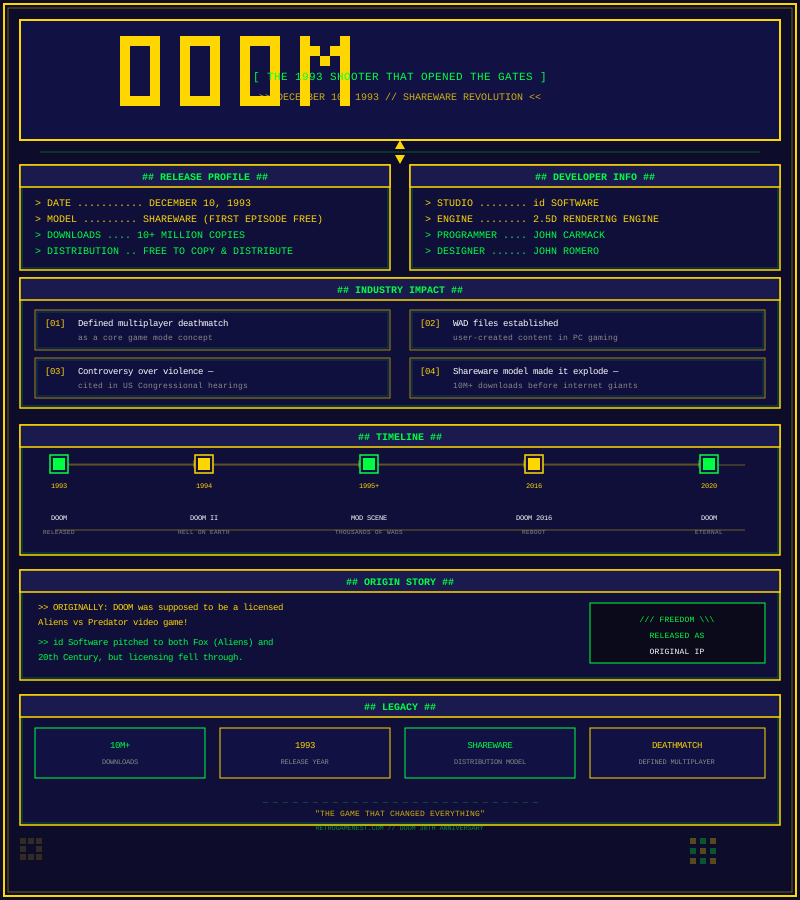 Doom pixel art infographic — 1993 shareware release, id Software, deathmatch origins, WAD modding, and controversy
Sources
- Doom Wiki: https://doomwiki.org/
- Bethesda/id Software — official Doom page: https://bethesda.net/en/game/doom
- DOOM + DOOM II on Steam: https://store.steampowered.com/app/2280/DOOM__DOOM_II/
- MobyGames — Doom (1993): https://www.mobygames.com/game/1068/doom/
- Masters of Doom by David Kushner (Random House, 2003) — the definitive account of id Software
FAQ
When was Doom released? December 10, 1993, as free shareware for MS-DOS.
Who made Doom? id Software — primarily John Carmack (engine), John Romero (levels), Sandy Petersen (additional levels), and Bobby Prince (music).
Is Doom actually 3D? No — it uses 2.5D rendering. True 3D features like rooms above rooms are not possible in the original engine.
How can I play Doom today? DOOM + DOOM II (2024) on Steam or GOG is the recommended legal option.
Was Doom controversial? Yes. It was cited in Congressional hearings about video game violence and in media coverage following the 1999 Columbine shooting.
Frequently Asked Questions
- When was the original Doom released?
- Doom was released on December 10, 1993 as shareware for MS-DOS. The first episode was free; the full three-episode game was available by mail order. It is one of the most significant software release dates in PC gaming history.
- Who made Doom?
- Doom was made by id Software, a small Texas-based studio. John Carmack wrote the engine and renderer. John Romero designed most of the levels. Sandy Petersen and American McGee contributed additional maps. The music was composed by Bobby Prince.
- Is Doom a 3D game?
- Not fully. Doom uses a 2.5D rendering technique — the world is built on a 2D map with height information added. True 3D elements like rooms above rooms are not possible in the original engine. This was a deliberate technical trade-off that allowed the game to run on 1993 PC hardware at playable speeds.
- Why was Doom controversial?
- Doom featured graphic violence including enemy dismemberment and blood. It was cited in Congressional hearings on video game violence (along with Mortal Kombat) and was mentioned in media coverage of the 1999 Columbine shooting years after release. It became a focal point for debates about violence in media.
- How can I play the original Doom today?
- The official re-release on Steam and GOG (DOOM + DOOM II, 2024) includes both games with modern source port support, online co-op, and all official add-on content. This is the recommended legal option.