Castlevania: Gothic Horror in the Age of Brutal Platformers
Castlevania brought gothic horror to the NES when every other platformer was bright, colorful, and punishing. How Konami's 1986 classic built genuine atmosphere, dread, and beauty on 8-bit hardware — and why it still feels different.
Last updated:
Quick Answer
Castlevania is a 1986 Konami action-platformer that did something no other NES game had done: it committed fully to gothic horror. Not as a theme slapped onto a platformer, but as a complete artistic direction — palette, music, level design, enemy roster, and movement all worked together to create dread. In an era when platformers were defined by bright skies, bouncy music, and arcade energy, Castlevania chose moonlight, minor-key melodies, deliberate movement, and monsters pulled straight from Universal and Hammer horror films.
Last Updated
May 27, 2026 — verified release dates, legal availability options, and composer credits against current sources.
Who This Guide Is For
This is for retro gamers curious about what made Castlevania stand apart in the NES library, fans of gothic horror in games, and anyone who wants to understand how Konami built genuine atmosphere on 8-bit hardware with severe technical limits.
Key Takeaways
- Castlevania launched on the Famicom Disk System in September 1986, arriving on the NES cartridge in North America in 1987
- It drew its visual and thematic identity directly from Universal Monster movies and Hammer Horror, not just vampire mythology
- The deliberate, committal movement system — locked jump arcs, knockback on damage, slow whip swings — was a design choice that reinforced tension
- The soundtrack by Kinuyo Yamashita used minor-key melodies and rhythm patterns inspired by film scores, not the upbeat chiptune convention of the era
- The NES could only display 25 colors at once; Castlevania’s palette selection — blacks, dark browns, stone grays, deep purples — was the foundation of its atmosphere
- Castlevania is available today in the Anniversary Collection and on Nintendo Switch Online
The Platformer Landscape of 1986
To understand why Castlevania felt different, look at what surrounded it.
In 1986, the NES platformer was defined by Super Mario Bros. — bright blue skies, green pipes, bouncy melodies, a hero who smiled. Mega Man followed in 1987 with a robot protagonist in primary colors. Even the harder-edged titles like Ghosts ‘n Goblins and Ninja Gaiden operated in a visual language that was colorful, fast, and arcade-derived. Difficulty was the common thread — these games were all “brutal” in the sense that they demanded tight execution, memorization, and many restarts.
Castlevania shared that difficulty. But it rejected almost everything else.
| Castlevania (1986) | Super Mario Bros. (1985) | Mega Man (1987) | Ghosts ‘n Goblins (1986) | |
|---|---|---|---|---|
| Tone | Gothic horror | Whimsical adventure | Sci-fi action | Dark fantasy comedy |
| Color palette | Black, brown, stone gray, deep red | Sky blue, green, red, yellow | Bright blue, cyan, yellow | Green, brown, blue sky |
| Protagonist | Vampire hunter with whip | Plumber jumping on enemies | Robot with arm cannon | Knight in boxer shorts |
| Setting | Dracula’s castle (interiors) | Mushroom Kingdom (outdoors, castles) | Robot master stages | Demon realm (outdoors and caves) |
| Music mood | Minor-key, tension, dread | Major-key, upbeat, bouncy | Energetic, melodic rock | Upbeat, adventurous |
| Movement feel | Deliberate, committal | Fluid, momentum-based | Precise, responsive | Deliberate, stiff |
| Damage system | Knockback on every hit | Shrink on hit, invincibility frames | Knockback, health bar | Armor breaks, then death |
Castlevania didn’t just add a horror skin to a platformer. Every design decision reinforced the gothic identity.
What Made Castlevania Gothic
The Color Palette
The NES could display a total of 25 colors simultaneously from a hardware palette of 54. Most platformers used the brighter half. Castlevania went dark.
The first stage opens inside Dracula’s castle gates — dark brown stone, black background voids, deep red brick accents. The sky is not visible. Every screen pushes the player deeper into an enclosed, decaying interior. When outdoor sections appear in later stages, the sky is a muted gray or a night-time black, never a cheerful blue.
This palette choice alone separated Castlevania from its peers. Where Mega Man greeted you with cyan skies and green fields, Castlevania’s first screen tells you: this is not a place you want to be.
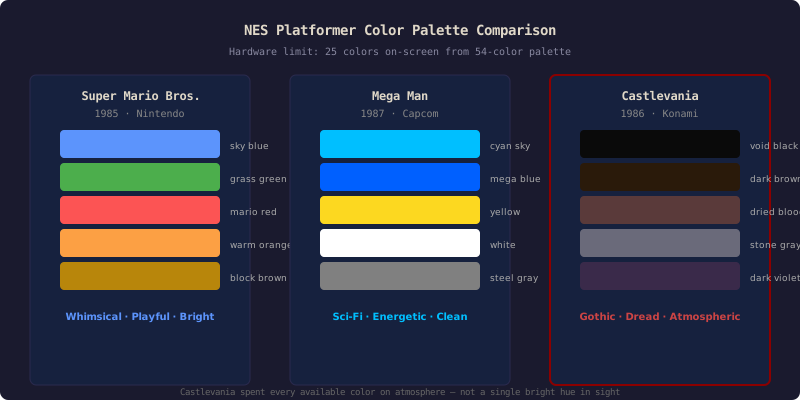 Castlevania’s color palette (right) versus its 1986-1987 peers. The NES had 25 on-screen colors — Castlevania spent every one on atmosphere.
Level Architecture
Castlevania’s level design creates claustrophobia. Corridors are narrow. Ceilings are low. Staircases force vertical ascents through tight shafts. The game rarely gives you an open, scrolling screen — instead, it locks the camera to room-sized chunks, each one a contained horror set-piece.
The clock tower stage is the clearest example: rotating gears, crumbling platforms, and Medusa Heads sweeping in sine-wave patterns through cramped vertical space. You cannot run through this stage. You inch forward, time your jumps around gear rotations, and fight the geometry itself.
Compare this to Super Mario Bros., where the screen scrolls freely rightward through open skies. Or Mega Man, where horizontal movement is the primary axis and vertical sections are brief. Castlevania forces ascent, descent, and navigation through enclosed spaces — a deliberate architectural choice that mirrors the gothic castle’s psychology.
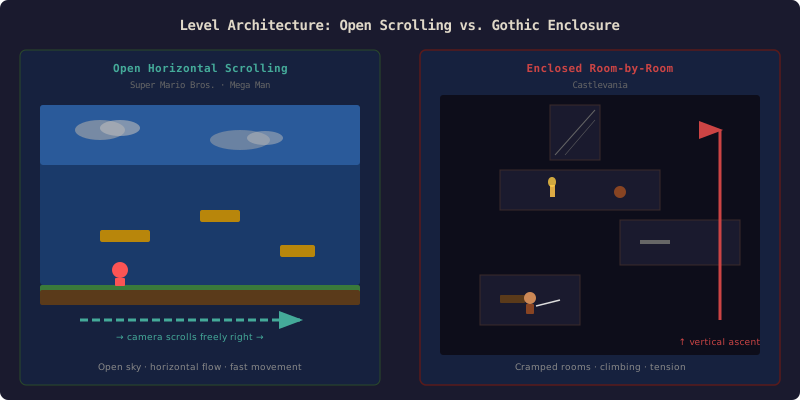 Most NES platformers scrolled right through open skies. Castlevania forced you up through cramped, enclosed rooms — architecture as atmosphere.
Protagonist and Movement
Simon Belmont does not feel like a superhero. He walks slowly. His whip has a deliberate wind-up. His jump arc, once committed, cannot be adjusted in mid-air — a design choice that would persist through the entire classic series.
When Simon takes damage, he recoils backward. On a narrow platform or next to a pit, one hit often means death by knockback into the void. This is not bad design — it’s a tension system. Every enemy encounter carries the threat of environmental death, not just health loss.
The whip itself reinforces the identity. It’s not a gun (Contra), a cannon (Mega Man), or a bounce attack (Mario). It’s a close-range, timing-based weapon with a satisfying crack. It’s personal, analog, and faintly ritualistic — exactly what a vampire hunter should carry.
The Soundtrack of Dread
Kinuyo Yamashita was a recent college graduate when she composed the Castlevania soundtrack. It was her first professional project. She approached it not as a chiptune exercise but as film scoring — using the NES’s five sound channels (two pulse waves, one triangle wave, one noise channel, one DPCM sample channel) to build tension, dread, and occasional beauty.
Key Tracks
| Track | Where It Plays | Atmospheric Function |
|---|---|---|
| Vampire Killer | Stage 1 (Castle Gate) | Sets the tone — driving minor-key rhythm, a declaration of intent. The most iconic track in the series. |
| Stalker | Stage 2 (Castle Interior) | Slower, more ominous. Emphasizes the descent into the castle’s depths. |
| Wicked Child | Stage 3 (Castle Exterior / Ruins) | Faster tempo, a moment of action relief before the difficulty spike. |
| Walking on the Edge | Stage 4 (Underground / Caverns) | Uneven rhythm patterns — the music itself feels unsteady, matching the precarious platforming. |
| Heart of Fire | Stage 5 (Dungeon / Prison) | Aggressive, urgent. The game is closing in on Dracula. |
| Out of Time | Stage 6 (Clock Tower) | The least melodic, most tension-focused track. Dissonant pulses — it barely qualifies as a “song” and that is exactly the point. |
Yamashita’s composition approach was closer to horror film scoring than video game music convention. She built tracks around atmosphere first, melody second. The result is a soundtrack that, even on 8-bit hardware, creates genuine unease.
Editor Note: What’s remarkable about Castlevania’s gothic identity is how much it achieved with so little. The NES could display 25 colors at once. The entire mood rests on which 25 Konami chose — and they chose black, deep brown, blood red, and stone gray.
Enemies as Horror Icons
Castlevania’s enemy roster reads like a Universal Monsters casting call. This was not accidental.
| Enemy | Horror Source | In-Game Behavior |
|---|---|---|
| Dracula | Bram Stoker’s novel, Universal’s Dracula (1931), Hammer’s Horror of Dracula (1958) | Final boss. Teleports, fires three projectiles. In his second form, transforms into a giant monster. |
| Frankenstein’s Monster & Igor | Universal’s Frankenstein (1931), Son of Frankenstein (1939) | Stage 4 boss duo. Igor hops around while the Monster walks slowly, dealing heavy damage on contact. |
| Medusa / Medusa Head | Greek mythology, Clash of the Titans (1981) | Flies in fixed sine-wave patterns. Cannot be reasoned with, only dodged. One of the most hated enemies in NES history. |
| Grim Reaper / Death | Medieval folklore, The Seventh Seal (1957) | Stage 5 boss. Throws spinning sickles in patterns. Appears in a room filled with floating sickles before the fight even starts. |
| The Mummy | Universal’s The Mummy (1932) | Stage 2 boss. Two mummies wrapped in bandages, throwing projectiles after unwrapping. |
| Phantom Bat | Universal’s Dracula (bat transformations), vampire folklore | Stage 1 boss. A giant bat that swoops in patterns. The first boss you face — the game announces its horror identity immediately. |
| Flea Men | Derived from folklore imps, gremlins | Small, fast enemies that hop in unpredictable arcs. Annoying rather than threatening — small horrors. |
| Bone Dragons | Skeletal dragon imagery from fantasy and horror art | Stationary enemies that breathe fire in patterns, usually placed to block narrow corridors. |
The genius is that these enemies don’t just reference horror — they behave like horror antagonists. Medusa Heads don’t attack you directly; they drift in fixed patterns that force you to time every movement. The Grim Reaper’s room fills with floating sickles before he even appears. Dracula teleports — you cannot pin him down. Each encounter is designed to create tension, not just test reflexes.
Comparison: Castlevania vs. Its Contemporaries
| Aspect | Castlevania | Mega Man | Contra | Ninja Gaiden |
|---|---|---|---|---|
| Visual identity | Gothic castle, moonlight, stone | Bright sci-fi, primary colors, clean lines | Military sci-fi, jungle, alien base | Cinematic action, city streets, dark but not gothic |
| Hero weapon | Whip (close-range, timing-based) | Arm cannon (ranged, rapid) | Spread gun, machine gun (ranged, spray) | Sword (close-range, fast) |
| Damage system | Knockback + health | Knockback + health | One-hit death | Knockback + health |
| Music identity | Minor-key tension, film-score approach | Melodic rock, energetic | Action-driven, military march | Cinematic, dramatic chiptune |
| Horror elements | Central identity — monsters, atmosphere, dread | None | Alien horror (final stages only) | Occasional dark imagery |
| Difficulty type | Methodical, memorization-heavy | Pattern-based, trial-and-error | Reflex-based, screen-memorization | Reflex + memorization, respawn-heavy |
| Legacy hook | ”The gothic platformer" | "The perfect action game" | "The co-op run-and-gun" | "The cinematic action game” |
Castlevania’s identity was so strong that it essentially created a sub-genre. Games that followed — from the entire Castlevania series itself to spiritual successors like Bloodstained — all build from the foundation of: platformer + gothic horror + deliberate combat = something distinct.
Author Tip: Castlevania rewards patience more than reflexes. Walk into new screens slowly — the game loves spawning Medusa Heads the moment you commit to a jump. Let the enemy come to you, use Holy Water on bosses, and remember: you can hold Up and press Attack to use sub-weapons without crouching.
Common Mistakes
- Rushing into new screens. Castlevania spawns enemies at screen edges. Walk forward one step at a time, trigger one enemy, deal with it, then advance. Sprinting will get you knocked into a pit before you know what hit you.
- Ignoring Holy Water. The stopwatch (freezes enemies) feels useful but Holy Water deals lingering damage and stuns bosses. Against the Grim Reaper and Dracula, Holy Water genuinely changes the fight.
- Wasting hearts on the dagger. The dagger is fast and travels across the screen — tempting. But it deals low damage and you’ll burn through hearts. Save hearts for Holy Water on bosses and the cross (boomerang) in corridors.
- Swinging the whip too early. The whip has a wind-up delay. Learn the rhythm — one swing covers the space directly in front of Simon. Swing when enemies enter that zone, not before.
- Holding onto the short whip. The whip upgrade (morning star) appears in candles and doubles your reach. Prioritize finding and keeping it — the short whip makes many enemy encounters significantly harder.
Checklist — First Playthrough Survival Guide
- Enter each new screen slowly — trigger one enemy at a time
- Find the morning star whip upgrade in Stage 1 and never lose it
- Pick up Holy Water before boss fights — drop the stopwatch and dagger
- Memorize Medusa Head spawn locations in the clock tower
- On the Grim Reaper: enter with full hearts, spam Holy Water while dodging sickles
- On Dracula’s first form: Holy Water stuns him, giving you time to whip his head
- On Dracula’s second form: stay on the ground, whip his projectiles, jump only when his jump forces you to
- If using the Anniversary Collection, save states are available — use them to practice boss patterns before attempting a clean run
FAQ
What year did the original Castlevania release? Castlevania launched on the Famicom Disk System in Japan on September 26, 1986. It arrived on the NES cartridge in North America in May 1987, followed by a European release in December 1988.
Who composed the Castlevania soundtrack? Kinuyo Yamashita composed the soundtrack, with Satoe Terashima handling sound programming. Yamashita joined Konami straight out of college and Castlevania was her first project. She approached the score like film music, prioritizing atmosphere over conventional video game melody.
Is Castlevania a horror game or an action game? It’s an action-platformer through and through — but one with a full gothic horror identity. You jump, whip, use sub-weapons, and fight bosses in sequence. The horror comes from the atmosphere: the palette, the music, the enemy designs, the architecture, and the tension systems built into the combat (knockback, locked jump arcs, deliberate movement).
Why is the original Castlevania so hard? Three design choices: (1) locked jump arcs — once you commit to a jump, the trajectory is fixed; (2) knockback on every hit — taking damage near a pit usually means death; (3) deliberate whip timing — you can’t spam attacks, each swing requires spacing and timing. These are not flaws — they’re tension systems that make every screen feel dangerous.
How is Castlevania different from Ghosts ‘n Goblins? Both are difficult, monster-themed platformers from the same era, but their tones differ. Ghosts ‘n Goblins is dark fantasy with comedic elements (Arthur loses his armor and fights in boxers). Castlevania plays it completely straight — the gothic horror is sincere. Musically and visually, Castlevania leans into dread while Ghosts ‘n Goblins stays adventurous.
Where can I play Castlevania legally in 2026? The Castlevania Anniversary Collection (2019) includes the NES original plus seven other classic titles and is available on Steam, PS4, Xbox One, and Nintendo Switch. The original is also available through Nintendo Switch Online’s NES library for subscribers. No need for ROMs — both options are inexpensive and official.
Did Castlevania invent the “gothic platformer” genre? Effectively, yes. Games with horror elements existed before 1986, but Castlevania was the first major title to make gothic horror its entire identity — not a level theme, not a boss, not an aesthetic accent, but a complete artistic statement that defined every aspect of the design. Every gothic action game that followed, from later Castlevanias to Bloodstained to Hollow Knight, stands on this foundation.
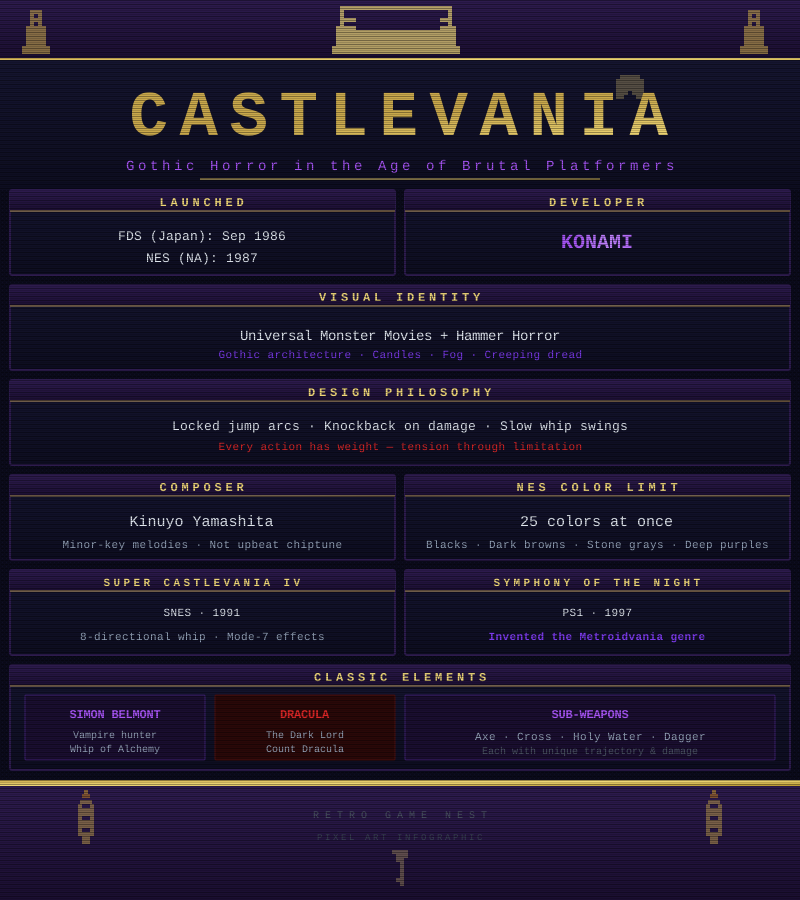 Castlevania pixel art infographic — 1986 release, gothic horror design, whip combat, soundtrack, and Metroidvania legacy
Sources
-
Hardcore Gaming 101 — Castlevania: comprehensive series history and analysis https://www.hardcoregaming101.net/castlevania/
-
Kinuyo Yamashita Interview — Square Enix Music Online: composer’s approach to the soundtrack https://www.squareenixmusic.com/features/interviews/kinuyoyamashita.shtml
-
MobyGames — Castlevania: release dates, credits, technical details https://www.mobygames.com/game/7403/castlevania/
-
Konami — Castlevania Anniversary Collection official page https://www.konami.com/games/castlevania/
-
Nintendo — Switch Online NES library https://www.nintendo.com/en-US/switch/online/
Frequently Asked Questions
- What year did Castlevania come out on NES?
- Castlevania released on the Famicom Disk System in Japan on September 26, 1986, and on the NES cartridge in North America in May 1987, followed by Europe in December 1988.
- Who composed the Castlevania soundtrack?
- Kinuyo Yamashita composed the original Castlevania soundtrack, with Satoe Terashima handling sound programming. Yamashita was a recent college graduate and Castlevania was her first professional project.
- What makes Castlevania a horror game?
- Castlevania is an action-platformer first, but draws its identity from gothic horror: Universal Monster-inspired enemies (Dracula, Frankenstein's Monster, Medusa), a crumbling castle setting, horror-film visual language, and a soundtrack built on tension and dread rather than upbeat energy.
- How difficult is the original Castlevania?
- Very difficult. Castlevania uses deliberate, committal movement — once Simon jumps, his arc is locked. Combined with knockback on every hit, enemy placements designed to punish rushing, and limited continues, the game demands patience and memorization.
- How can I play Castlevania legally today?
- Castlevania is available in the Castlevania Anniversary Collection (2019) on PC, PS4, Xbox One, and Nintendo Switch, which includes the NES original plus seven other classic titles. It's also on Nintendo Switch Online's NES library for subscribers.