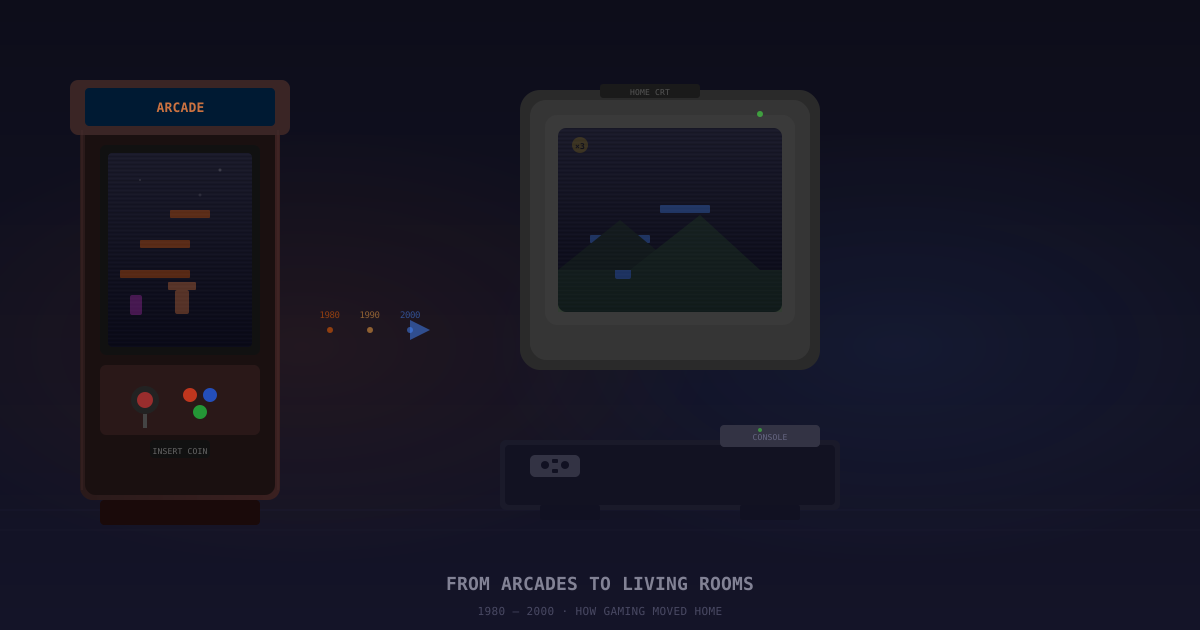
From Arcade Halls to Living Rooms: How Gaming Moved Into Our Homes (1980–2000)
The 20-year journey from the golden age of arcade halls in the 1980s to consoles conquering living rooms in the 2000s. From Space Invaders to PlayStation 2 — the story of gaming moving into our homes, technological leaps, console wars, and what we lost along the way.
Last updated:
Quick Answer
In 1980, if you wanted to play video games, you had to leave your house. Arcade halls — dark, noisy, neon-lit spaces — were the only place for gaming. By 2000, the PlayStation 2 had sold 155 million units worldwide, becoming the best-selling console in history. Living rooms had become the new arcade halls.
This 20-year transformation — from arcade cabinet to home television, from coin-operated to CD-ROM, from anonymous rivals to online multiplayer — fundamentally changed how video games were played, who played them, and what gaming meant. This article is the full story of that journey.
Last Updated
Content reviewed in May 2026. Console sales figures verified against official manufacturer data; historical events confirmed through Wikipedia and contemporary gaming press archives. All games and consoles mentioned remain accessible on the retro gaming market.
Who Is This Guide For?
- Retro gamers who grew up in the 1980s and 1990s, feeding coins into arcade machines
- Younger gamers who missed the arcade era and are curious about this critical transition in gaming history
- Gaming historians looking to understand the economic and cultural transformation of the gaming industry
- Collectors wondering why the NES, SNES, Genesis, and PlayStation were so important
Key Takeaways
- The golden age of arcade halls (1978–1986) turned gaming into a mass entertainment medium — Space Invaders, Pac-Man, and Donkey Kong became cultural icons
- The 1983 crash collapsed both the console and arcade markets; Nintendo rebuilt the industry from scratch with the NES and strict quality control
- The 16-bit era (SNES vs Genesis) brought arcade quality into homes — the SNES port of Street Fighter II sold over 6 million copies, a console game record at the time
- The Sony PlayStation (1994) completely transformed gaming with CD-ROM, 3D graphics, and cinematic storytelling — ending the arcade’s technical superiority forever
- The transition was not just technical but social: gaming shifted from a communal public activity to a private home-based one
- Arcades didn’t die — they survive as a cultural institution in Japan, and through the barcade concept in the West
The Golden Age of Arcades: The Birth of Gaming Halls
In 1978, when Taito released Space Invaders in Japan, the impact was so massive that a shortage of 100-yen coins occurred. Gaming arcades turned into entertainment hubs overnight. In the US, arcade revenues reached $8 billion in 1982 — more than the combined total of the film and music industries that same year.
Arcade Hall Culture
Arcade halls weren’t just places to play games. They were dark spaces lit by the CRT screens of cabinets, filled with the beeps and synth music blending from speakers. A crowd would form around every cabinet. Getting your initials AAA on the high score table meant recognition in your neighborhood.
Milestones of the era:
- Pac-Man (1980): Namco’s yellow circle sold over 400,000 cabinets, with an estimated total revenue exceeding $14 billion as of 2023
- Donkey Kong (1981): Nintendo’s first major hit — the birth of Mario (then called Jumpman) and the modern platforming genre
- Dragon’s Lair (1983): Full animation graphics using LaserDisc technology — the technical peak of arcades
The Coin Economy
Arcade games were specifically designed to be long enough to entertain, but hard enough to eat another coin. A typical game lasted 2-3 minutes. A skilled player could stretch a single coin to 15-20 minutes — and that was considered an achievement.
Street Fighter II (1991) changed this model. Players were no longer playing against the machine, but against each other. The loser stepped aside, the winner stayed. Coins lined up on the cabinet marked whose turn was next. This was esports in its most primitive and purest form.
 Arcade halls were the social fabric of gaming — each cabinet became a mini arena, every high score a badge of prestige.
The 1983 Crash: When Everything Fell Apart
In 1983, the video game industry collapsed overnight. The North American gaming market dropped from $3.2 billion in 1982 to $100 million in 1985 — a 97% contraction. The cause: uncontrolled growth, a flood of low-quality games (including Atari 2600’s infamous E.T. disaster), and the rise of home computers.
Arcade halls took their share of the hit too. Revenue dropped, many halls closed. But the real blow to arcades was yet to come — because Nintendo was about to leave Tokyo for New York.
Nintendo and the Rebirth of the Home Console
In 1985, Nintendo released the Nintendo Entertainment System (NES) in America. Hiroshi Yamauchi’s strategy was brilliant: market the NES not as a “game system,” but as an “entertainment system.” It came bundled with the Robotic Operating System (R.O.B.) — to make the box look like a toy. Retailers didn’t even want to hear the words “video game”; Nintendo sold them a toy with a robot.
The Nintendo Seal and Quality Control
Nintendo’s real revolution wasn’t hardware, but its licensing model. Every NES game had to pass Nintendo’s approval. A limit of no more than 5 games per year per publisher, licensing fees, and Nintendo’s monopoly on cartridge manufacturing made a quality disaster like 1983’s impossible.
Super Mario Bros. (1985) sold over 40 million copies. The Legend of Zelda (1986), with its save feature (battery-backed RAM), freed games from the “beat it in one sitting” requirement. The NES sold a total of 61.91 million units, rebuilding the home console market from the ground up.
Console Wars: Sega Genesis vs Super Nintendo
In the early 1990s, two Japanese giants were fiercely battling for the home gaming market. Sega’s slogan “Genesis does what Nintendon’t” and Sonic the Hedgehog’s cool attitude challenged Nintendo’s Mario and family-friendly image.
The Significance of the 16-Bit Era
16-bit consoles could bring arcade games home with near-perfect fidelity. The SNES port of Street Fighter II sold 6.3 million copies — the best-selling third-party game of its era. Mortal Kombat, NBA Jam, Final Fight… these games no longer needed coins.
| Feature | Super Nintendo | Sega Genesis |
|---|---|---|
| Release | 1990 (JP), 1991 (US) | 1988 (JP), 1989 (US) |
| Total Sales | 49.1 million | 30.75 million |
| Strength | Color palette, Mode 7, sound chip | Faster processor, sports games |
| Mascot | Mario | Sonic |
| Arcade Port Quality | Superior (SFII, Final Fight) | Good (Mortal Kombat with blood code) |
This battle wasn’t just about hardware — it was a battle of identity. Sega represented “cool,” Nintendo represented “safe.” And this competition pushed both sides to make better games.
 From Space Invaders to PlayStation 2: the distance gaming traveled in 20 years.
Technological Leaps: The Innovations That Brought Gaming Home
The transition from arcade to home wasn’t just a marketing strategy — it was the result of a series of technological breakthroughs.
Cartridges and Storage
NES cartridges offered between 8KB and 1MB of storage. Arcade PCBs, on the other hand, used much larger ROM chips. By the 16-bit era, this gap had closed — SNES and Genesis cartridges could hold up to 4MB, meaning arcade-quality sprites and sound at home.
The CD-ROM Revolution
In the mid-1990s, CD-ROM changed everything. A CD could hold 650MB of data — over 160 times more than the largest cartridge. This meant CD-quality audio, FMV (Full Motion Video) cutscenes, and cinematic storytelling.
The Sega CD (1991) was an early experiment, but Sony delivered the real blow. The PlayStation (1994) was fully CD-based, and games like Final Fantasy VII (1997) offered something arcades could never provide: a 40-hour cinematic story.
3D Graphics and GPUs
The PlayStation’s 3D geometry engine and the Nintendo 64’s Reality Coprocessor — developed in collaboration with Silicon Graphics — gave home consoles 3D capabilities that surpassed arcades. Super Mario 64 (1996) defined the 3D platforming genre. Gran Turismo (1997) brought realistic car physics into the living room.
The arcade hall’s “big screen, superior graphics” advantage had vanished forever.
The Quiet Decline of Arcades
By the late 1990s, arcade halls were closing. The reasons:
-
Economics: An arcade game cost $10-20 per hour. Playing the same game unlimited times at home cost $50. The math was brutal.
-
Technical Parity: After 1995, home consoles were more powerful than arcade hardware. Sega’s Model 3 arcade board (1996) was still impressive, but the Dreamcast (1998) was already nearly identical to the NAOMI arcade board. The phrase “arcade-perfect port” lost its meaning.
-
Cultural Shift: Internet cafes, LAN parties, and online gaming became the new social spaces. Counter-Strike and StarCraft offered far deeper social experiences at a PC than arcades ever could.
-
The Sony Effect: The PlayStation stopped gaming from being “just for kids.” Wipeout was being played at nightclubs. Gaming was now adult entertainment, and adults preferred to play at home.
What We Gained, What We Lost
Gains
- Accessibility: Gaming anytime, anywhere. No carrying coins, no waiting in line. With save features, you can continue from wherever you left off.
- Depth: 40-100 hour RPGs, cinematic stories, open worlds — game genres that were impossible in the arcade format.
- Variety: Arcades focused heavily on action, racing, and fighting games. Home consoles embraced every genre — simulation, strategy, role-playing, puzzle, and more.
- Personal Space: The freedom to experience games at your own pace, however you like.
Losses
- Social Fabric: Arcade halls brought demographics together. Businessmen, students, everyone played shoulder to shoulder in the same space. Home gaming individualized the experience.
- Physical Competition: Seeing your opponent, watching their hands, feeling the energy of the crowd — online gaming can’t replicate any of this.
- Philosophy of Difficulty: Arcade games were hard to make you “drop in another coin.” This created a design philosophy that rewarded mastery but was merciless. Modern games are far more forgiving.
- Public Gaming Space: Gaming is now a private, indoor activity. There’s no thrill of unexpected discovery — finding a cabinet on the street, in a shopping mall, or at a resort.
The Legacy of Arcades: A Culture That Never Fully Disappeared
Arcades didn’t die — they evolved. In Japan, Taito Hey Akihabara, Sega’s GiGO chain, and countless independent game halls are still thriving. In the West, Galloping Ghost Arcade (Chicago), Arcade Club (UK), and the barcade concept (Barcade chain, Two Bit Circus) are carrying the arcade experience to new generations.
And perhaps most importantly: the spirit of the arcade lives on. In fighting game community (FGC) tournaments, at EVO, even at retro gaming meetups — people are still playing side by side on the same cabinet with the same joystick. Because some things have no online alternative.
Common Mistakes
- Thinking arcades only died because of consoles. The 1983 crash, changing entertainment habits, internet cafes, and mobile gaming all contributed to shrinking the arcade market. There’s no single culprit — the times changed.
- Thinking the NES was the first home console. The Atari 2600 sold 30 million units. There were also the Intellivision, ColecoVision, and Magnavox Odyssey². The NES succeeded because it rebuilt trust after the industry collapsed.
- Misunderstanding the term “arcade-perfect port.” During the SNES and Genesis era, ports called “arcade-perfect” actually weren’t — sprite counts were reduced, animation frames cut, and sound quality compressed. True “arcade-perfect” ports only became possible in the Dreamcast/PS2 era.
- Thinking PlayStation started everything. Before Sony, the 3DO, CD-i, and Sega CD all tried CD-ROM. The PlayStation was simply the first console to do it right — that’s all.
Author’s Recommendation
If you want to experience the real atmosphere of an arcade hall, visit your nearest retro arcade bar or Akihabara on a trip to Japan. But my real recommendation: set up an arcade stick (with Hori or Sanwa parts), a CRT monitor, and MAME with original ROMs. Playing Street Fighter II with a real joystick on a CRT with scanlines is a completely different experience from playing on a modern LCD with a gamepad. That click sound, that spring resistance — that’s the DNA of arcades.
Editor’s Note
The timeline in this article was written from a Western perspective. In Japan, arcade halls were never considered “dead” — as of 2024, Japan still has over 4,000 active arcade halls. Additionally, South Korea’s PC bangs created a hybrid culture between arcades and home gaming. Gaming history isn’t universal — it varies by geography.
Checklist: Experience the Journey from Arcade to Home
- Install an arcade emulator (MAME) — play original arcade ROMs
- Try Pac-Man, Donkey Kong, and Space Invaders at original arcade difficulty
- Play Street Fighter II with an arcade stick (not a gamepad)
- Play Super Mario Bros. on original NES hardware or accurate emulation — no save states!
- Compare Street Fighter II Turbo on SNES with Sonic the Hedgehog 2 on Genesis
- Play Final Fantasy VII or Metal Gear Solid on a PlayStation to witness the CD-ROM generation
- Visit a retro arcade bar or game hall if possible
- Find a CRT television and play retro games on it — see the difference from modern displays
Sources
- Golden Age of Arcade Games — Wikipedia, wikipedia.org/wiki/Golden_age_of_arcade_video_games
- History of Video Game Consoles (Third through Sixth Generation) — Wikipedia, wikipedia.org/wiki/History_of_video_game_consoles
- How Nintendo Saved the Video Game Industry — IGN, ign.com
- Sega Genesis vs Super Nintendo: The Console War — Polygon, polygon.com
- PlayStation: The Console That Changed Gaming Forever — Eurogamer, eurogamer.net
- The Death and Legacy of Arcades — Kotaku, kotaku.com
Frequently Asked Questions
When did the golden age of arcade halls end?
There’s no definitive date for the end of the golden age, but the 1983 crash and the subsequent rise of the NES (1985-1986) are generally considered the turning point. Some historians view the second wave that Street Fighter II brought to arcades in 1991 as “the golden age’s last hurrah.” Arcade revenues never again reached the 1982 peak.
Did Sega Genesis or Super Nintendo win?
By sales numbers, the SNES (49.1 million vs 30.75 million). But it varies by region: the Genesis competed head-to-head in the US, even leading in 1992-1993. Sega was very strong in Europe and Brazil. In Japan, the SNES had an overwhelming advantage. The “winner” depends on geography.
Did PlayStation really kill arcades?
Not directly, but it can be said to have landed the final blow. PlayStation’s real impact was changing the demographic and cultural position of gaming — it not only pulled the “young male” audience that arcades targeted into homes, but also made gaming appealing to adults. Arcades couldn’t compete because the experience PlayStation offered (a 40-hour RPG, cinematic story, save feature) was impossible in the arcade format.
Where can I play original arcade games today?
The MAME emulator can run thousands of arcade games on a computer. The Arcade Archives series (Nintendo Switch, PS4) offers officially licensed arcade ports. Hamster Corporation’s ACA Neo Geo series faithfully ports original Neo Geo games. Physically, you can visit Galloping Ghost Arcade (Chicago, 900+ cabinets), Arcade Club (UK), and the Strong Museum of Play (Rochester, NY).
Why did the Atari 2600 era fail as a “transition from arcade to home”?
The Atari 2600 could bring the name of arcade games home, but not the experience. The Atari 2600 port of Pac-Man was a disaster — flickering ghosts, a different maze layout, terrible sound effects. This taught the industry a lesson: “a name isn’t enough, you have to deliver the experience.” Nintendo took this lesson to heart and put far more care into arcade ports on the NES.
Frequently Asked Questions
- When was the golden age of arcade halls?
- The golden age of arcade halls roughly lasted from 1978 to 1986. Starting with games like Space Invaders (1978), Pac-Man (1980), and Donkey Kong (1981), this period turned gaming arcades into a global phenomenon. In the US, arcade revenues reached $8 billion in 1982, surpassing both the film and music industries combined. This era ended with the 1983 video game crash.
- Why did arcade halls lose their popularity?
- Three main reasons: (1) Home consoles technically approached arcade quality — especially during the 16-bit era, the SNES and Genesis delivered arcade ports nearly identical to the originals. (2) Economics — an arcade game could cost $10-20 per hour, while playing the same game unlimited times at home cost $50-60. (3) Cultural shift — in the 1990s, internet cafes, house parties, and LAN parties became the new social gaming spaces.
- What was the first successful home console?
- The Atari 2600 (1977) achieved the first widespread success — selling over 30 million units. However, the 1983 video game crash collapsed Atari's market. The Nintendo Entertainment System (NES, 1983/1985) rebuilt the home console market from scratch, selling over 61 million units with its quality control system (Nintendo Seal of Quality) and games like Super Mario Bros., ushering in the modern console era.
- How did PlayStation change the gaming world?
- The Sony PlayStation (1994) completely transformed gaming with its CD-ROM format, 3D graphics capabilities, and marketing strategy targeting adults. Selling 102 million units, it became the best-selling console of its era. Games like Final Fantasy VII, Metal Gear Solid, and Gran Turismo brought cinematic storytelling and realistic simulation to home gaming. It permanently eliminated the 'big screen' advantage of arcade halls.
- What did we lose in the transition from arcade culture to home gaming?
- The biggest loss was the social dimension of gaming. Arcade halls were physical meeting points — you could see your rivals, feel the energy of the crowd, and meet new people while waiting in line. Home gaming was more comfortable and economical, but it individualized the experience. Additionally, the high difficulty level of arcades (designed to eat more coins) gave way to more accessible games with save features.
Sources
- The Golden Age of Arcade Games — Wikipedia
- History of Video Game Consoles — Wikipedia
- How Nintendo Saved the Video Game Industry — IGN
- Sega Genesis vs Super Nintendo: The Console War That Defined a Generation — Polygon
- PlayStation: The Console That Changed Gaming Forever — Eurogamer
- The Death and Legacy of Arcades — Kotaku