Before Online Multiplayer: Split Screen, Link Cables, and the Golden Age of Couch Co-op
Before Xbox Live, PSN, and Steam friends lists, multiplayer gaming meant split screens, physical link cables, LAN parties, and crowded arcades. A nostalgic look at how gamers connected before the internet took over — and what we lost along the way.
Last updated:
Quick Answer
Before Xbox Live, PSN, Steam friends lists, and Discord voice chat, multiplayer gaming was a physical experience. You sat next to your opponent on a couch with a split TV screen between you. You carried your heavy CRT monitor to a friend’s basement for a LAN party. You connected two Game Boys with a plastic cable to trade Pokémon. And before that, you stood shoulder to shoulder in a smoky arcade, stacking quarters on the cabinet to claim “next.”
This was multiplayer before the internet — and while online services made gaming more convenient, they also changed the social fabric of how we play together in ways that are worth remembering.
Last Updated
Content reviewed May 2026. Historical facts cross-referenced with Wikipedia game databases and contemporary reporting. Xbox Live launch date and Dreamcast online service details verified. Indie game availability checked on Steam.
Who This Guide Is For
- Retro gamers nostalgic for the couch co-op era of the 1990s and early 2000s
- Younger players curious about how multiplayer worked before broadband internet
- Game historians and preservationists interested in the social history of gaming
- Developers and designers thinking about what local multiplayer achieved that online still can’t
Key Takeaways
- Multiplayer gaming evolved through four distinct pre-online eras: arcade (1970s–80s), split-screen consoles (1990s), link cables (1990s–early 2000s), and LAN parties (1990s–early 2000s)
- Split-screen gaming peaked with the N64 and PS2 — GoldenEye 007, Mario Kart 64, and Halo: CE defined entire social circles
- Game Boy link cables turned handheld gaming into a face-to-face social activity and made Pokémon a cultural phenomenon
- Xbox Live (2002) was the inflection point — it proved online console gaming was viable and profitable, and publishers quickly shifted resources away from local multiplayer
- LAN parties were a logistical headache (hauling CRTs, configuring IPX/SPX protocols) but created gaming memories that Discord servers can’t replicate
- Split-screen hasn’t disappeared — indie games like Overcooked, TowerFall, and It Takes Two have revived same-room multiplayer for a new generation
The Arcade: Where Multiplayer Was Born
Before anyone had a console at home, multiplayer meant going somewhere. The arcade was the original social gaming network — a physical space where strangers became rivals and spectators crowded around cabinets to watch the best players.
High Scores as Social Currency
In the golden age of arcades (late 1970s through the mid-1980s), multiplayer wasn’t simultaneous. It was asynchronous competition through the high score table. You put your initials — AAA, ACE, GOD — next to a number, and the next person who walked up tried to beat it. Space Invaders (1978), Asteroids (1979), and Pac-Man (1980) built communities around these leaderboards, even though two people never played at the same time.
Shoulder-to-Shoulder Competition
Everything changed with fighting games. Street Fighter II (1991) turned the arcade into a coliseum. Two players, standing side by side at the same cabinet, facing off in real time. The loser stepped aside; the winner stayed. A row of quarters on the cabinet bezel signaled the queue. Mortal Kombat (1992) added gore and controversy, drawing even bigger crowds.
This was multiplayer in its most raw form: physical, immediate, and public. You could see your opponent’s hands. You could hear their reactions. There was no latency, no lag switching, no anonymous toxicity — just two people in the same room, with a crowd watching.
 Arcades were the original multiplayer lobbies — physical spaces where competition was face-to-face and quarters held your place in line.
The Split-Screen Era: Four Players, One TV
The Nintendo 64 didn’t invent split-screen gaming, but it perfected it. The console shipped with four controller ports — no multitap required — and its library was built around the idea that gaming was better with friends in the room.
The N64 Golden Age
GoldenEye 007 (1997) is the definitive split-screen experience. Four players, one CRT TV, and an unspoken gentleman’s agreement: no screen-peeking. (Everyone screen-peeked.) The game’s multiplayer mode — Facility, proximity mines, Oddjob banned — became a social ritual for an entire generation.
Mario Kart 64 (1996) turned split-screen into chaos. Four racers, shells flying, and a Battle Mode map called Block Fort that settled more friendships than it ended. The game didn’t need matchmaking or ranked tiers — the ranking was whoever was sitting on your couch.
Super Smash Bros. (1999) added four-player brawling to the mix. The screen zoomed out as characters spread apart, making everyone squint at the same CRT, leaning forward as the match got intense. It was inelegant, cramped, and absolutely perfect.
The Peak: Halo and the Original Xbox
When Halo: Combat Evolved launched with the Xbox in 2001, it took split-screen to a new level. Two players could play through the entire campaign in co-op — a rarity for an FPS at the time — and up to four could compete in multiplayer via split-screen. But Bungie didn’t stop there: Xbox System Link allowed up to 16 players by connecting four Xbox consoles with four TVs, each running four-player split-screen. You didn’t need the internet. You needed four CRTs, four Xboxes, a pile of Ethernet cables, and a very patient host.
Halo 2 (2004) still supported split-screen, but it also launched with Xbox Live integration. The writing was on the wall.
Why Split-Screen Worked (and Why It Faded)
Split-screen was a technical compromise — rendering the same scene from two or four different angles at once — but it created a social experience that online play still struggles to replicate. The trash talk was in the room, not in a headset. The post-match handshake (or shove) was real. And crucially, only one person needed to own the game.
This last point is why publishers let split-screen die. Four players on one copy of GoldenEye meant three potential sales lost. Online multiplayer requires every player to own the game, the console, and in modern terms, a subscription. The economics of online play are simply more favorable to the industry.
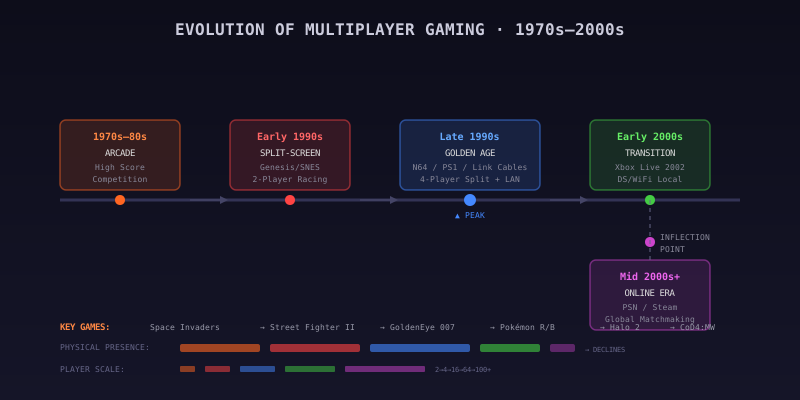 The 30-year arc of multiplayer gaming: from public arcades to private couches to global server farms.
Link Cables: When Handhelds Became Social
The Game Boy launched in 1989 as a solitary device — one player, one screen, one cartridge. But Nintendo had included a mysterious port on the side of the unit: the Game Link Cable port. It would take a few years, but that port would transform handheld gaming.
How the Link Cable Worked
The Game Boy Link Cable was elegantly simple: a physical wire with proprietary plugs on both ends. Two Game Boys connected directly, and games could send data back and forth through a simple serial protocol. No networking stack, no IP addresses, no configuration. Plug it in, both players select “Link Mode” in the game, and it works.
Pokémon: The Killer App
Pokémon Red and Blue (1996 in Japan, 1998 in the West) made the link cable essential. The games were designed around trading and battling — core mechanics that required a second player with a second cartridge and a cable. You couldn’t complete the Pokédex without trading version-exclusive Pokémon. Nintendo sold the cable separately, but eventually bundled it with the games because every player needed one.
The genius of the design was social: to catch ‘em all, you had to find another human being. School playgrounds became trading hubs. Link cable meetups were organized. Pokémon didn’t just sell 31 million copies — it created a physical social network of players that no online service could have replicated at the time.
Beyond Pokémon
Tetris (Game Boy, 1989) supported two-player competitive play via link cable. F-1 Race offered four-player racing with a four-player adapter. The Game Boy Advance extended the concept with the Game Boy Advance Game Link Cable and Wireless Adapter, supporting games like The Legend of Zelda: Four Swords — a four-player co-op Zelda game that required four GBAs, four cartridges, and cables (or wireless adapters) to play.
The PSP and DS would later include built-in wireless for local multiplayer — a bridge between the cable era and the online era. But the physical act of connecting two devices with a cable had a ritual quality. It made multiplayer feel like a deliberate act, not a menu option.
LAN Parties: The Pilgrimage Era
Before broadband internet was fast and cheap enough for online gaming, PC gamers solved the problem with brute force: they brought the entire network to one location.
What a LAN Party Actually Required
Hosting a LAN party in the late 1990s was a feat of logistics. Each attendee needed:
- A desktop PC (often a full tower)
- A CRT monitor (15–21 inches, weighing 15–30 kg)
- Keyboard, mouse, mousepad
- Power cables and a power strip
- An Ethernet cable (usually Cat5)
- Their game discs and any required patches on floppy or CD
The host needed a network switch or hub (10BASE-T or later 100BASE-TX), enough power outlets to avoid tripping breakers, and the patience to configure IPX/SPX or TCP/IP settings on a dozen different machines running different versions of Windows.
The Games That Defined LAN Culture
Doom (1993) was the pioneer. id Software’s deathmatch mode — up to four players — was originally designed for LAN play. Quake (1996) expanded this with full 3D and dedicated server support. QuakeWorld added client-side prediction, making online play viable, but LAN remained the gold standard: zero latency, no packet loss.
StarCraft (1998) turned LAN parties into all-nighters. A single match could last hours, and the social dynamic of sitting across from your opponent, watching them build their base on their screen while you scouted it on yours, created a psychological dimension that online play lost. You could see their expression. You knew when they were stressed.
Counter-Strike (1999, as a Half-Life mod) brought tactical team play to LANs. Five players on each side, coordinated through shouting across the room rather than voice chat. The energy of a LAN Counter-Strike match — everyone yelling “B! B! HE’S GOING B!” — has never been replicated online.
Why LAN Parties Ended
Broadband killed the LAN party, but gradually. Counter-Strike 1.6 and StarCraft: Brood War were still perfectly playable online with a decent DSL connection. By the mid-2000s, cable and fiber internet had made online play good enough that the logistical nightmare of a LAN party seemed unnecessary. Steam (2003) centralized PC gaming. Discord (2015) replaced the social function of being in the same room.
Major LAN events still exist — DreamHack, QuakeCon, Insomnia — but they’re now esports festivals and conventions, not the basement gatherings of the 1990s. The era of hauling a 20 kg CRT to a friend’s house to play Quake for eight hours is over.
The Inflection Point: Xbox Live (2002)
On November 15, 2002, Microsoft launched Xbox Live. It wasn’t the first online console service — the Dreamcast had a built-in modem and supported online play for games like Phantasy Star Online as early as 2000 — but Xbox Live was the first to get it right.
What Xbox Live Changed
- Unified friends list: One gamertag, one list, across all games. No more swapping IP addresses or configuring network settings per game.
- Matchmaking: Press a button, find opponents. No forum coordination, no scheduling.
- Voice chat: The Xbox Communicator headset came in the box. Suddenly you could talk to strangers while playing — for better and worse.
- Subscription model: $49.99/year. This was the real revolution. Microsoft proved that console players would pay a recurring fee for online access, and every publisher noticed.
The Aftermath
By 2005, the Xbox 360 and PS3 had made online multiplayer standard. Split-screen began disappearing from AAA games. Halo 3 (2007) still supported four-player split-screen, but it would be the last mainline Halo to do so. Halo 5: Guardians (2015) dropped split-screen entirely, and the backlash was significant but ultimately didn’t change the trajectory.
Call of Duty 4: Modern Warfare (2007) redefined console FPS multiplayer around online progression — unlocks, prestiges, killstreaks. The couch co-op FPS was officially a niche.
What We Gained, What We Lost
Gains
- Convenience: Play with anyone, anywhere, anytime. No scheduling, no travel, no hardware logistics.
- Scale: Online games support hundreds of players in a single match. Battle royale games like Fortnite and PUBG would be impossible as local multiplayer experiences.
- Matchmaking: Skill-based matchmaking means you usually play against people at your level instead of whoever happened to be in the room.
- Persistence: Online profiles, achievements, and progression systems give multiplayer gaming a sense of continuity across sessions.
Losses
- Physical presence: You can’t read body language through a headset. You can’t high-five your teammate after a clutch play. The social bandwidth of being in the same room is orders of magnitude higher than any chat app.
- Trash talk with consequences: Online anonymity enables toxicity that would never happen face-to-face. In a LAN or arcade, there were social guardrails. Online, those guardrails disappear.
- Equal hardware: At a LAN or on a couch, everyone played on the same setup. Online, hardware disparities — monitor refresh rates, internet quality, controller types — create an uneven playing field.
- The spectator experience: Watching a friend play a single-player game on the same couch, passing the controller, backseat gaming — these are multiplayer-adjacent experiences that streaming and Discord can approximate but never fully replace.
The Revival: Indie Games Keep the Couch Alive
Split-screen and local multiplayer haven’t disappeared — they’ve just moved from AAA blockbusters to indie games. A few standout examples:
| Game | Year | Players | Why It Works |
|---|---|---|---|
| TowerFall Ascension | 2013 | 2–4 | Arrow combat arena where screen-peeking is irrelevant — everyone shares one screen |
| Overcooked | 2016 | 2–4 | Chaotic kitchen co-op that requires constant shouting and coordination |
| It Takes Two | 2021 | 2 | Mandatory split-screen co-op with no single-player option — a deliberate design statement |
| Screencheat | 2014 | 2–4 | An FPS where everyone is invisible and you MUST screen-peek to find opponents |
| Crawl | 2017 | 2–4 | One player is the hero, the other three are monsters — roles rotate on death |
These games prove that local multiplayer still has an audience. They just target a different demographic — party gamers rather than competitive FPS players — and operate at a different budget level.
Common Mistakes
- Assuming online replaced local purely because it’s superior. It didn’t. Online won because each player needs their own copy, console, and (often) subscription. Four players on one couch with one disc is a lost sale to a publisher. The transition was economic, not just technical.
- Forgetting that split-screen is rendering-intensive. Rendering a scene four times from four angles is far more demanding than rendering it once. As games pushed for higher visual fidelity, split-screen became a technical liability. It’s not that developers hate couch co-op — it’s that adding it means downgrading graphics for all players.
- Overlooking the Dreamcast. Sega’s console had a built-in 56k modem in 1999, supported online play for Phantasy Star Online, and even had a web browser. Xbox Live gets the credit, but the Dreamcast planted the flag first.
- Thinking link cables were Game Boy only. The Neo Geo Pocket, PlayStation (with the Link Cable for the original model), and even the Xbox (System Link) used physical cable connections for local multiplayer. The concept spanned platforms.
Author Tip
If you want to experience what gaming was like before online multiplayer, don’t just emulate — use original hardware. Find a CRT TV (still available on classifieds for free or cheap), an N64 with four controllers, and a copy of GoldenEye 007. The input lag on a modern LCD ruins the split-screen FPS experience, and emulator netplay doesn’t capture the physical presence of three friends on a couch. The hardware is the experience.
Editor Note
The numbers tell a clear story. In 2001, nearly every major console FPS supported four-player split-screen. By 2015, Halo 5 shipped without it, and the gaming press treated it as a scandal. But the indie response has been remarkable — It Takes Two won Game of the Year in 2021 with a game that literally cannot be played alone. Local multiplayer isn’t dead. It just moved house.
Checklist: Recapturing Pre-Online Multiplayer
- Find a CRT TV — 20” or larger, preferably with composite or S-Video input
- Acquire an N64 or original Xbox with four controllers
- Get GoldenEye 007, Mario Kart 64, Super Smash Bros., or Halo: CE
- Invite three friends who understand the “no Oddjob” rule
- Stock snacks that won’t grease up the controllers
- Accept that screen-peeking will happen and is part of the experience
- For LAN nostalgia: set up a Quake III Arena or StarCraft server on a local switch and play with sub-5ms ping
- For link cable nostalgia: find two Game Boy Advances, two copies of a Pokémon game, and a GBA link cable
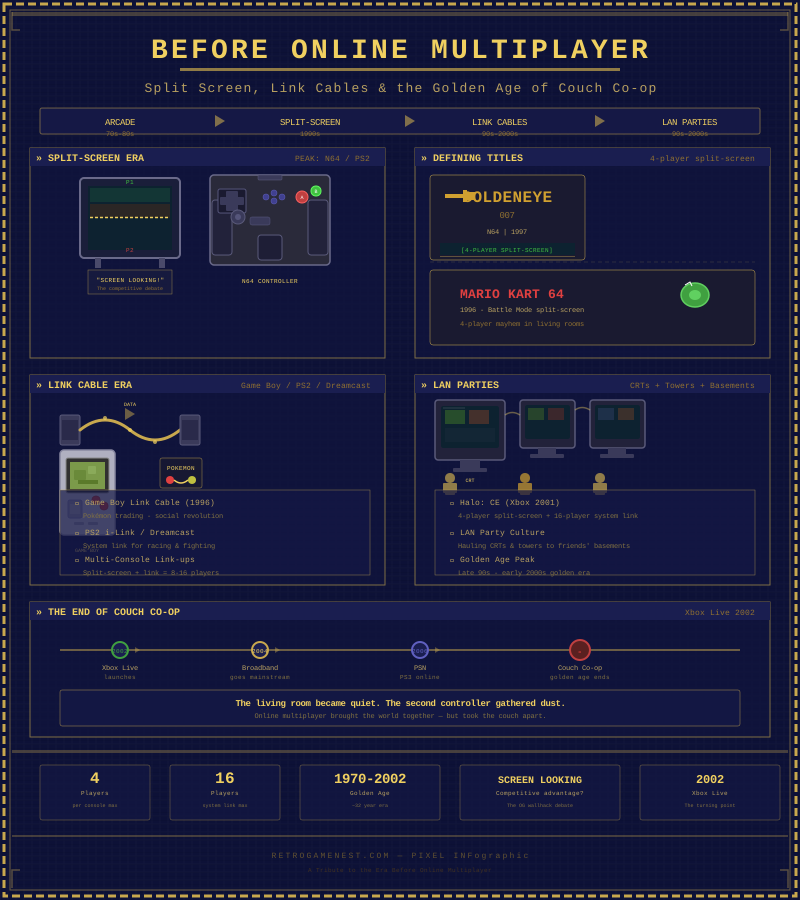 Before Online Multiplayer pixel art infographic — split-screen, link cables, LAN parties, and the golden age of couch co-op
Sources
- History of LAN Parties — Wikipedia, wikipedia.org/wiki/LAN_party
- Game Boy Link Cable — Nintendo Wiki, nintendo.fandom.com/wiki/Game_Link_Cable
- The Rise and Fall of Split-Screen Multiplayer — IGN, ign.com
- Xbox Live launch and history — Eurogamer, eurogamer.net
- System Link: Xbox’s forgotten LAN feature — Digital Foundry / Eurogamer, eurogamer.net
- The Golden Age of Arcades — Polygon, polygon.com
FAQ
What was the first console game with split-screen multiplayer? The Atari 2600 had some two-player simultaneous games as early as 1977 (Combat, Air-Sea Battle), but these were shared-screen rather than split-screen. True split-screen — where each player sees a different viewport — emerged later with racing games on the Genesis and SNES. The N64 made it a standard feature.
How fast was the Game Boy link cable? The original Game Boy link cable transferred data at roughly 8 Kbps (kilobits per second). It was a simple serial connection — barely enough for turn-based battles and trading, which is why most link cable games were turn-based rather than real-time.
Did the PS2 have online multiplayer? Yes, but it required the PlayStation 2 Network Adapter (sold separately), which added an Ethernet port to the back of the console. Games like SOCOM: U.S. Navy SEALs, Final Fantasy XI, and Tony Hawk’s Pro Skater 3 supported online play. However, the PS2’s online features were fragmented — no unified service like Xbox Live — and adoption was low compared to offline split-screen.
What’s the biggest LAN party ever recorded? DreamHack Winter 2013 in Jönköping, Sweden, recorded over 22,000 unique devices connected to its local network. Modern DreamHack events still feature massive LAN areas, though they’re now part esports festival, part convention.
Will split-screen ever return to AAA games? Unlikely at scale. The economic incentives haven’t changed — publishers still prefer each player to buy their own copy. But games like Baldur’s Gate 3 (2023), which includes split-screen co-op, show that some studios still see value in local multiplayer. The future of couch co-op is probably in the indie space, where the economics of “one sale, multiple players” aren’t seen as a loss but as a feature.
Frequently Asked Questions
- What is split-screen gaming?
- Split-screen gaming divides a single TV display into two or four sections, each showing a different player's perspective. Popularized in the 1990s by games like GoldenEye 007 (N64) and Mario Kart 64, it allowed 2–4 players to compete or cooperate on one console with one TV. It was the default multiplayer mode before online console gaming became standard.
- How did Game Boy link cables work?
- The Game Boy Link Cable was a physical wire connecting two Game Boy consoles via their external link ports. It allowed two players to battle, trade Pokémon, or play co-op games like Tetris and F-1 Race. The cable used a simple serial protocol — each Game Boy sent and received data through the wire. Later models (Game Boy Color, Advance) added support for up to 4 players with a hub accessory.
- What was a LAN party?
- A LAN (Local Area Network) party was a gathering where gamers brought their desktop PCs and CRT monitors to one location — a basement, garage, or rented hall — connected them via Ethernet cables and switches, and played multiplayer games like Doom, Quake, StarCraft, and Counter-Strike together with zero latency. LAN parties peaked in the late 1990s and early 2000s, before broadband internet made online play practical.
- Why did split-screen gaming decline?
- Split-screen declined for several reasons: (1) Online multiplayer became standard with Xbox Live (2002) and PSN (2006), removing the need for physical proximity. (2) Rendering two or four separate viewpoints is GPU-intensive, and developers prioritized single-player visual fidelity. (3) Game publishers earn more from selling individual copies and online subscriptions than from one-disc couch co-op. However, indie games like Overcooked and It Takes Two have revived the format in recent years.
- Can you still play link cable games today?
- Yes, with original hardware and cables (available on eBay and retro game stores). Emulators also support link cable emulation — for example, VisualBoyAdvance and mGBA can emulate Game Boy link cable connections between two emulator instances on the same PC. Some FPGA-based devices like the Analogue Pocket also support physical link cable play.