Tekken 3: PlayStation's Fighting King
Namco's 1997 arcade hit Tekken 3 arrived on PlayStation in 1998 and delivered more than just a port — it offered a home experience that surpassed the arcade original. With 8.5 million copies sold, this fighting masterpiece defined a generation.
Last updated:
Quick Answer
Tekken 3 is more than a fighting game — it’s a technical triumph for the PlayStation, a textbook example of arcade-to-console conversion, and the pinnacle of 3D fighting in the late 1990s. When Namco’s 1997 arcade hit landed on PlayStation in 1998, it wasn’t just a successful port — it was a richer package than the arcade original: more characters, brand new game modes (Tekken Force, Tekken Ball), and a fluid 3D fighting engine that squeezed every last drop of power from the console’s hardware. With 8.5 million copies sold, it became the PS1’s best-selling fighting game, and it still ranks near the top of all-time greatest fighting game lists today.
Last Updated
Content reviewed in May 2026. Sales figures confirmed from Namco Bandai corporate reports. PlayStation Store availability checked at time of writing.
Who This Guide Is For
- Retro gamers who played Tekken 3 as kids and want to remember what made it so special
- New-generation players curious about the evolution of 3D fighting games
- Game historians studying the finest examples of arcade-to-console ports
- Retro collectors interested in the technical achievements of the PlayStation 1 era
Key Takeaways
- Tekken 3 hit arcades (Namco System 12) in March 1997; arrived on PlayStation in March 1998 and sold 8.5 million copies
- The PS1 port, while running at a lower resolution than arcade, surpassed the arcade experience with added content
- The sidestep mechanic revolutionized the 3D fighting genre and became the standard for the entire genre
- New characters like Jin Kazama, Hwoarang, Ling Xiaoyu, Eddy Gordo, and Bryan Fury became the backbone of the series
- Side modes like Tekken Force and Tekken Ball raised the bar for single-player content in fighting games
- Its legacy: laid the mechanical foundation for 3D fighting games, still played on the esports scene, and regarded as a pinnacle of the PS1 library
From Arcade to PlayStation: A Near-Flawless Port
Namco developed a graphics engine specifically optimized for the PlayStation hardware with Tekken 3. The 60 FPS smoothness of the arcade version dropped to 30 FPS on PlayStation — but Namco made a clever choice: they kept character animations at 60 FPS while rendering backgrounds at 30 FPS. The result was gameplay that felt just as fluid as the arcade.
Background details were reduced and resolution was lowered, but Namco more than made up for these “losses” with new content. The PS1 version added:
- 2 new characters: Anna Williams and Dr. Bosconovitch
- Tekken Force: A Final Fight-style beat-em-up mode — a four-stage side story
- Tekken Ball: A beach volleyball mode where two players hit a ball at each other to deal damage
- FMV cinematics: Arcade-quality opening and ending videos for every character
- Unlockable content: Extra costumes, characters, and game modes
This wasn’t a port — it was an expansion pack.
A New Generation of Fighters: Roster Revolution
Tekken 3 rewrote the series’ character philosophy. Most of the Tekken 2 roster was either cut or completely overhauled. The new generation that took their place defined the series’ future:
| Character | Fighting Style | Series Role |
|---|---|---|
| Jin Kazama | Mishima-ryu Karate | Main protagonist, Kazuya’s son, Heihachi’s grandson |
| Hwoarang | Taekwondo | Jin’s rival, the series’ first Taekwondo character |
| Ling Xiaoyu | Baguazhang/Piguaquan | A Chinese student who wants to become Heihachi’s bodyguard |
| Eddy Gordo | Capoeira | Seeks his father’s killer, the most popular low-level character |
| Bryan Fury | Kickboxing | A former police officer turned undead cyborg |
| King II | Pro Wrestling | The successor from the original King’s orphanage |
| Julia Chang | Xing Yi Quan | Michelle Chang’s adopted daughter |
This new lineup moved away from Tekken 2’s more serious tone, offering a more diverse and colorful character roster. Eddy Gordo’s capoeira drew from Brazil, Hwoarang’s Taekwondo from Korea, Ling Xiaoyu’s Chinese martial arts from Asia — Tekken 3 was a global fighting festival.
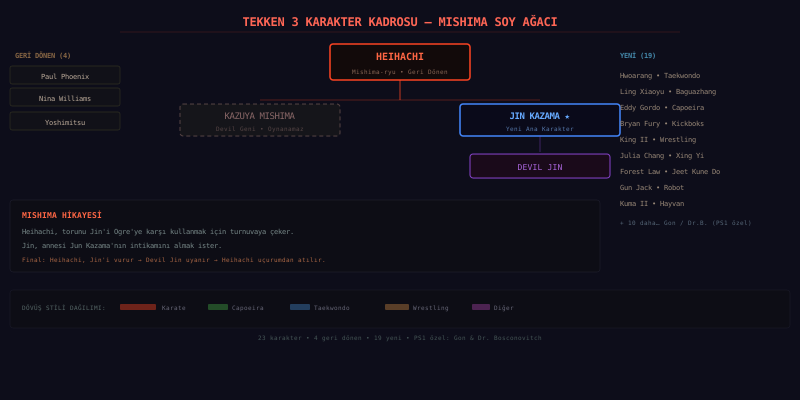 Tekken 3’s 23-character roster introduced the series’ most iconic fighters and set a new standard for fighting game character design.
Mechanical Revolution: Sidestep and 3D Movement
Tekken 3’s biggest technical contribution was the sidestep mechanic. In earlier 3D fighters (Virtua Fighter, Tekken 2), 3D movement was limited — mostly dodging into the background or slow lateral walking. In Tekken 3, a slight tap up or down would make your character quickly sidestep, evading linear attacks.
This fundamentally changed fighting games:
- Linear attacks were no longer safe. A Mishima’s Electric Wind God Fist was powerful, but it could be completely avoided with a sidestep.
- Positioning became critical. Walls and arena edges became strategic threats.
- Mind games deepened. Anticipating your opponent’s sidestep and using homing attacks added a new layer of strategy.
Juggle System
Tekken 3’s “juggle” mechanic became the series’ hallmark. Launching an opponent into the air and landing additional hits before they hit the ground was the core measure of character mastery. Every character had different launchers and juggle combinations. Learning King’s chain grappling combos could take weeks — and that depth extended the game’s competitive lifespan for years.
Pushing the PS1 Hardware to Its Limits
Namco put the PlayStation’s hardware to masterful use. The PS1’s 33.8 MHz MIPS processor and 1 MB VRAM were modest compared to 1997 arcade hardware. But Namco’s approach was smart:
- Texture management: Character textures were kept at high resolution; backgrounds were optimized with simpler geometry.
- Animation priority: 60 FPS character animations preserved the fluid gameplay feel.
- CD-ROM advantage: Music and cinematics, limited by ROM in the arcade, shone at full capacity on PS1’s CD-ROM. Tekken 3’s soundtrack (composed by Keiichi Okabe and Nobuyoshi Sano) is counted among the genre’s best.
Game Modes: Beyond Fighting
Tekken 3 redefined what single-player content could be in fighting games:
Tekken Force
A Final Fight-style beat-em-up played from a side camera angle. You control Jin Kazama through four stages fighting waves of enemies. Completing the mode unlocks Dr. Bosconovitch. Simple but addictive — seeing a side mode like this in a fighting game was astonishing in 1998.
Tekken Ball
A beach volleyball mode where two players hit a ball at each other to deal damage. The ball speeds up and gains damage with each hit. Seemingly ridiculous, incredibly fun in practice. Tekken Ball could be just as competitive as the main fighting mode when played with friends.
Arcade Mode + Time Attack + Survival + Team Battle + Practice
Even the standard modes surpassed the competition of the era. Practice mode displayed the move list on screen, making it easy to learn commands. Team Battle allowed 8-on-8 character selections for extended tournaments.
Tekken 3’s Legacy
Tekken 3’s influence extends far beyond its sales figures:
- 3D fighting standard: Sidestep, juggles, and movement-priority gameplay formed the foundation of all modern 3D fighting games.
- Character design: Jin, Hwoarang, Xiaoyu, King, and Eddy remain series staples after more than 25 years.
- Esports scene: The Tekken series is one of EVO’s longest-running games. Tekken 7 (2015) and Tekken 8 (2024) built upon the foundations laid by Tekken 3.
- Cultural impact: Tekken 3 solidified the PlayStation’s image as a console “for everyone.” It was equally appealing to fighting game fans, casual players, and arcade regulars.
Common Mistakes
- Thinking the port is “worse.” Technically, yes, it runs at lower resolution than the arcade. But in terms of content, the PS1 version eclipses the arcade. Tekken Force, Tekken Ball, FMVs, and extra characters make this an upgrade, not a downgrade.
- Only playing Eddy Gordo. Eddy is overpowered at low levels, but relying solely on him means missing the game’s depth. You can’t experience Tekken 3’s real depth without learning other characters’ mechanics.
- Attacking without moving. Standing still and trying to execute combos is suicide against experienced players. In Tekken 3, movement — sidestep, backdash, wavedash — is at least as important as attacks.
- Viewing Tekken 3 as just a “party game.” Yes, Tekken Ball and Tekken Force are fun party modes. But the game’s competitive depth is strong enough to be represented on the EVO stage even 20+ years later.
Author Tip
If you want to play Tekken 3 on original hardware, find a CRT TV. On modern LCDs, the PS1’s 240p output looks blurry and laggy. On a CRT, the image is sharp, colors are vibrant, and input lag is virtually nonexistent. The DuckStation emulator offers an excellent alternative with 4K upscaling and low-latency modes — you can play legally by using your original disc image.
Editor Note
What sets Tekken 3 apart from other PS1 fighting games is Namco’s deep understanding of the hardware. Many arcade ports from the same era (Mortal Kombat 4, Street Fighter EX) either compromised on quality or fell short in content. Tekken 3, by contrast, felt right at home on the PlayStation. It deserves to be studied not just as a great game, but as a great platform adaptation.
Checklist: The Complete Tekken 3 Experience
- Beat Arcade Mode with at least 3 different characters — each has a unique ending cinematic
- Complete all four stages of Tekken Force to unlock Dr. Bosconovitch
- Play at least 5 rounds of Tekken Ball against a friend
- Learn a character’s 10-hit combo from start to finish in Practice mode
- Consciously use sidestep + punish mechanics in a boss fight
- Practice King’s Rolling Death Cradle grappling chain (warning: it takes time)
- Listen to the original soundtrack in a separate session — especially the Jin Kazama and Hwoarang themes
Sources
- Tekken 3 — Wikipedia, wikipedia.org/wiki/Tekken_3
- Tekken Series Sales Data — Namco Bandai, bandainamcoent.co.jp
- Tekken 3 Retrospective — IGN, ign.com
- The Making of Tekken 3 — Polygon, polygon.com
- Tekken 3 Technical Analysis — Retro Gamer Magazine, retrogamer.net
FAQ
What do I need to play Tekken 3 on original PlayStation? A PlayStation 1 or PS2 (backward compatible), an original Tekken 3 disc, a memory card, and preferably a CRT TV. PS1 games can also be played on PS3 (certain models). A digital version occasionally appears on the PlayStation Store during retro game promotions, but it is not permanently listed.
Who is the strongest character in Tekken 3? In competitive tier lists, Jin Kazama and Heihachi usually rank at the top — Jin’s Electric Wind God Fist and mix-up game are unmatched. At casual levels, however, Eddy Gordo and Hwoarang are the most effective characters thanks to their spam-friendly moves. King’s chain grappling combos are deadly in the hands of a skilled player.
What are the biggest differences between Tekken 3 and Tekken 2? Tekken 3 added the sidestep mechanic, completely overhauled the graphics engine, changed most of the character roster, significantly increased game speed, and added side modes like Tekken Force and Tekken Ball. Tekken 2 was a slower, heavier, and more limited experience. Tekken 3 is more fluid, faster, and deeper in every way.
Is Gon still playable? Yes — Gon (a small manga dinosaur) is Tekken 3’s guest character and is playable in the PS1 version. He does not appear in the arcade version. Gon’s tiny size causes most high attacks to miss him — this “troll” character dynamic makes him controversial in competitive matches. Licensing issues prevented him from returning in later Tekken games.
What is the best music track in Tekken 3? Subjectively speaking, the tracks that stand out most in community polls are: Jin Kazama’s theme (“Jin Kazama”), Hwoarang’s theme (“Hwoarang”), King’s theme (“King”), and the console version’s character select screen music. The soundtrack was composed by Keiichi Okabe (later the composer for the Nier series) and Nobuyoshi Sano.
Frequently Asked Questions
- When was Tekken 3 released?
- Tekken 3 first launched in arcades (on the Namco System 12 board) in March 1997. The PlayStation port followed on March 26, 1998 in Japan, April 29, 1998 in North America, and September 1998 in Europe. Despite arriving a year after the arcade version, the PS1 release surpassed the original thanks to its wealth of added content.
- How many characters are in Tekken 3?
- The arcade version features 21 characters. The PlayStation release bumps that up to 23: the 21 arcade fighters plus 2 PS1-exclusive characters (Anna Williams and Dr. Bosconovitch). Gon (Tekken 3's guest character) and various unlockable costumes are also available. Most returning characters from Tekken 2 received completely overhauled movesets, while newcomers like Jin Kazama, Hwoarang, Ling Xiaoyu, Eddy Gordo, and Bryan Fury became the backbone of the series.
- Why is Tekken 3 considered one of the best fighting games ever?
- Three main reasons: (1) The fluid 3D movement system — the sidestep mechanic revolutionized the fighting genre. (2) A near-seamless arcade-to-PS1 port — Namco optimized the PlayStation hardware to deliver arcade-quality graphics at 60 FPS. (3) An abundance of content — Tekken Force beat-em-up mode, Tekken Ball beach volleyball, unlockable characters and cinematics offered package value far beyond its era.
- What is the story of Tekken 3?
- Tekken 3 takes place 19 years after Tekken 2. Heihachi Mishima seeks out his grandson Jin Kazama to train him. Meanwhile, the ancient war god Ogre has awakened and is attacking the world's strongest fighters. Heihachi organizes the King of Iron Fist Tournament 3 to lure Ogre into a trap. Jin's mother Jun Kazama is killed by Ogre, and Jin enters his grandfather's tournament seeking revenge.
- How can I play Tekken 3 today?
- You can play it on PS1, PS2, or PS3 with the original PlayStation disc. It's not part of the PS Classics digital catalog, though it may occasionally appear on the PlayStation Store during retro game promotions. On the emulation side, DuckStation or RetroArch (Beetle PSX HW core) lets you play with upscaled 4K resolution. The original arcade version can be emulated through MAME.